
Air-Power Precision
Load controller technology helps Central Bridge orient 230-foot girders safely and accurately
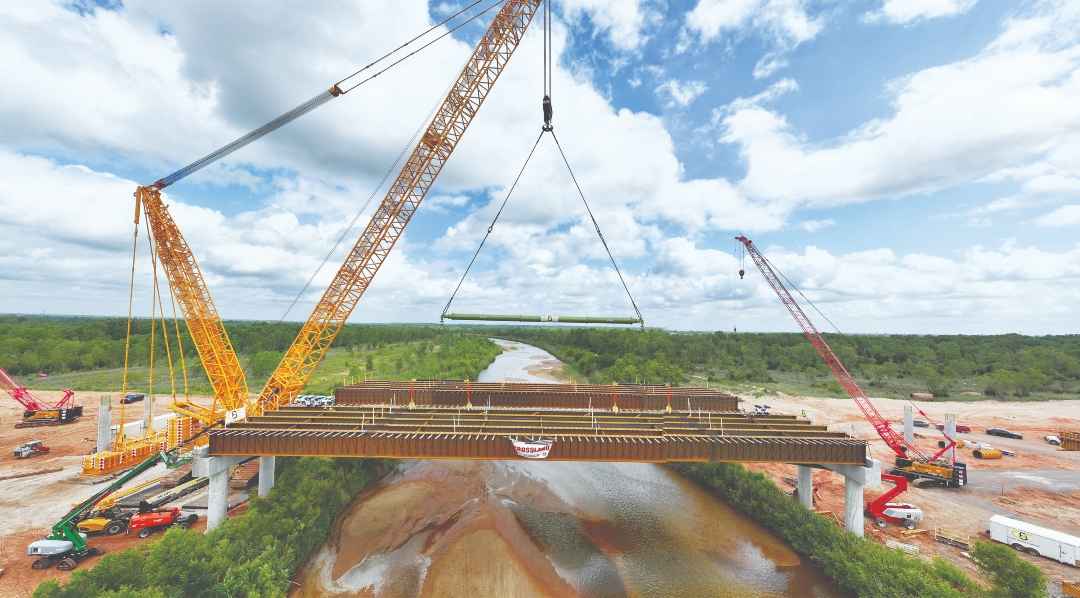
For the first two bridges built for Oklahoma’s Toby Keith Expressway, a Liebherr LR 11000 crane with 264-foot boom and a hanging auxiliary counterweight set 10 steel girders at a 152-foot radius for two parallel bridges. Each load was 230 feet long, 8 feet high, and weighed between 180,000 and 426,000 pounds. Two remote-operated Vita Load Navigator 2.0 load controllers used air propulsion to control girder rotation and alignment.
The Toby Keith Expressway (TKE) now being built in metropolitan Oklahoma City is a major turnpike project that will add 28 miles of highway to the area and cost an estimated $3 billion to build by the time it’s completed in 2033..
The $97-million first phase of the TKE is called the South Canadian River Bridge project. It kicked off this February and is led by general contractor Crossland Construction.
Other members of the project team for this first phase of the TKE include owner Oklahoma Turnpike Authority, steel erector Central Bridge Company, crane service provider Northwest Crane Service, and load control provider Vita Industrial.
When general contractor Crossland awarded Central Bridge the contract to build piers and erect steel for the first phase of the TKE project, Central Bridge’s leaders knew that the job would bring some interesting challenges.
The first was that every lift would be made in front of an audience of local dignitaries, since this was among the first major work being done on the high-profile TKE project.
The second was that the 11/4-mile bridge would cross a river and a flood plain, so there were environmental considerations to accommodate.
And third, sandy soil on the east side of the South Canadian river meant massive steel bridge girders would have to be picked and placed by a single crane sitting on the river’s west side — and that they would have to be controlled without conventional taglines.
Looking for a solution to the load-control challenge, Central Bridge President Gary Quinonez remembered seeing Vita Industrial demonstrate Vita Load Navigators at the ConExpo trade show in 2023 and 2026, so he reached out to Caleb “Rosie” Rosenberger, Vita Industrial’s global executive account manager, product training.
“Even if the jobsite arrangement would have enabled using taglines, the girders were just too large for humans to control by using them,” said Quinonez. “The Navigators were a better answer.”
Cooperative Effort
In just two and a half months, Quinonez, Rosenberger, two Vita engineers, and Greg White and Reece Fuller from Northwest Crane analyzed the girder-control challenge and devised a plan to use two Vita Load Navigator 2.0 load controllers to manage rotation of the 10 girders, which measured 230 feet long, 8 feet high, and weighed up to 426,000 pounds per lift.
“Whenever we plan lifts that combine a Vita Load Navigator with a crane, we collaborate with the crane user or a lift planner to make sure the load reactions and wind loadings stay safely within the crane’s design,” said Rosenberger.
“This was a first for all of us,” said Quinonez. “No one had ever before paired two air-propulsion load controllers on something this big, let alone in the kind of winds common in Oklahoma.”
After confirming that the two-Navigator system would be an excellent solution for controlling each load without taglines, Central Bridge rented two Vita Load Navigator 2.0 units, and the lifting team worked out the details of the setup.
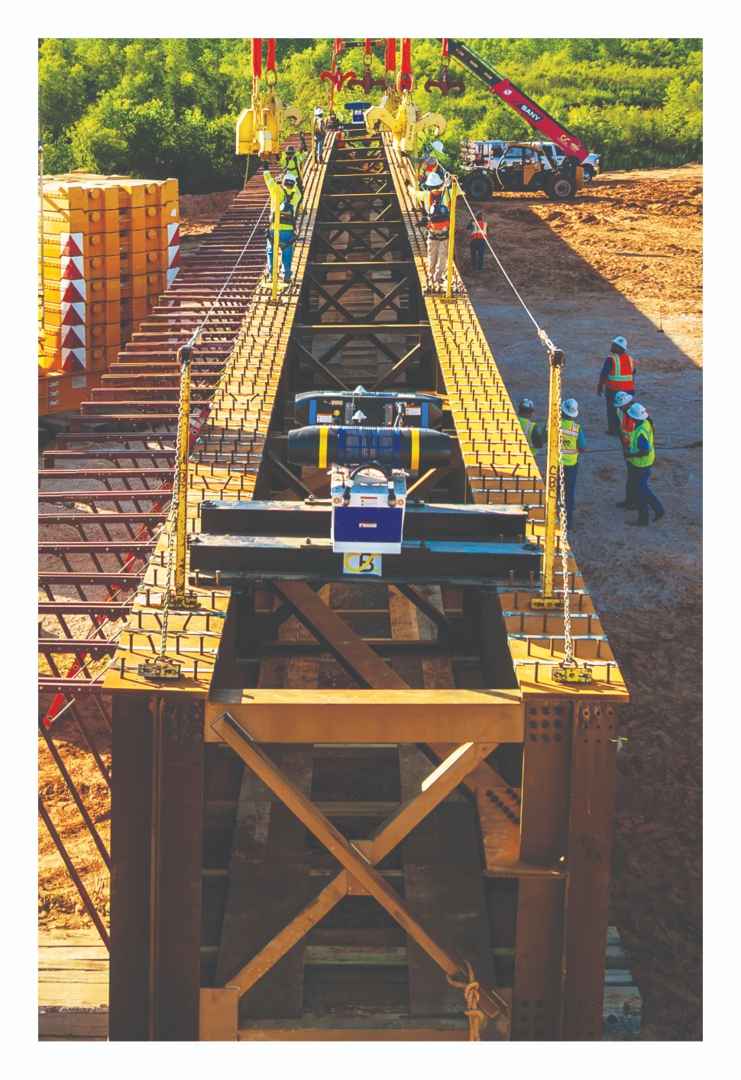
The team decided the most effective arrangement would be to mount one Navigator 2.0 near each end of the single or double girders that were being lifted, arrange for the two Navigators to talk to each other so they could work in unison, and design the control system so both could be operated with just one wireless remote control.
Precise Process
Too long to be shipped in one piece, each girder arrived from the fabricator as one 120-foot and two 55-foot sections.
Central Bridge bolted the three sections into one girder 230 feet long by 8 feet tall.
To help assure the girders would sit stable once they were in place on the piers, eight of the girders were connected into pairs with cross bracing before being picked and placed as two-girder units.
The remaining two girders were set as singles that were connected to their adjacent girder after being set in place.
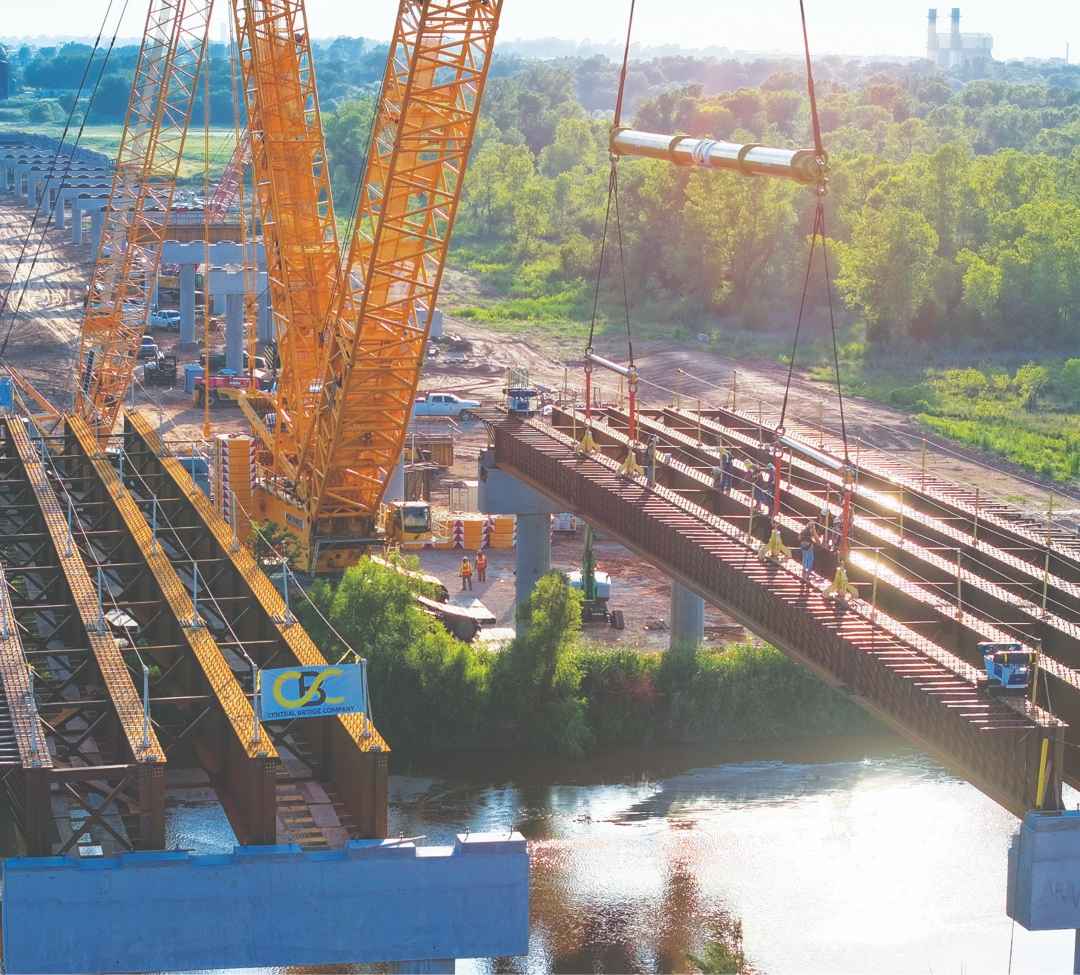
When a girder or connected pair of girders had been assembled, Central Bridge used a 300-ton Liebherr LR 1300 and a 135-ton Sany SCA 1350A in tandem to walk the girder(s) to the big LR 11000 for picking and placing.
That is when the Vita Navigator 2.0 load controllers were mounted near each end and clamped securely in place by a custom frame designed by Quinonez, who has a master’s degree in structural engineering from the University of Oklahoma.
Each of the six girder-setting lifts followed the same precise process, whether the load was a pair of joined girders or a single one.
The LR 11000’s operator swung the upperworks so the counterweights faced the river, and the load was rigged to the crane’s load block using wire-rope slings, spreaders, and beam clamps.
The operator then lifted the girder high enough so it would clear the pier that sat between the crane and the river before swinging 180 degrees so the girder hung over the river and parallel to the bank.
The operator held it in that position while the crane’s derrick, or mast, was connected to an auxiliary counterweight that would be needed to counterbalance the load as the crane boomed out to a radius of 152 feet to set the girder onto supporting piers.
Once the auxiliary counterweight had been attached, the crane operator boomed down, and when the girder was far enough out so it could be turned without hitting the crane’s boom, it was rotated about 90 degrees to align with the bearing blocks on the piers.
Throughout the entire lift, the girder’s horizontal positioning was regulated precisely by air power from the two Vita Navigator 2.0 load controllers, which were run by an operator on the ground who was in continual voice contact with the crane operator.
Rosenberger ran the Navigators for the first two lifts, and Quinonez ran them for the other four.
“Working with the crane operator was really easy,” said Quinonez. “He just let me know where he was in the lift process and what was needed to properly position the girder. It all went very smoothly.”
Quinonez added that the controller was easy to learn and to use. “The wireless remote was compact, easy to hold, and has just six buttons,” he said. “I watched Rosie do the first two lifts, and knew just what to do when I took over after that.”
Each lift took from one and a half to two hours, and the battery-powered, radio-remote controlled Vita Navigators kept the 230-foot-long, 8-foot tall girder positioned to within 1 degree in winds that blew at up to 15 miles per hour.
One of the Navigator 2.0’s features is a “hold” function that lets the unit automatically adjust its output to hold a load in a chosen position.
That eliminates the need for the Navigator operator to manually adjust operation when a load needs to stay stationary for longer times.
“To control loads of this size so precisely without taglines in the wind is a real achievement,” said Quinonez. “We set each girder onto its bearing plates within about a 1/4-inch tolerance longitudinally and a 1/8- inch accuracy laterally.”
Versatile Design
Rosenberger explained that the Vita Navigator 2.0 is designed with the flexibility to be customized to a customer’s needs.
For example up to six Navigators can be connected to communicate with each other by wire, by Ethernet, or even wirelessly.
Their lithium batteries provide up to 12 hours of operation per charge, can be recharged in 6 hours by plugging into 110-, 220-, or 240-volt power, and when plugged in can keep operating the Navigator while charging.

Two battery-powered, remote-operated, Vita Load Navigator 2.0 air-propulsion load controllers, visible near each end of the girders, eliminated the need for taglines. The Navigators rotated this 230-foot, 426,000-pound double girder with 1-degree accuracy in winds that blew at up to 15 miles per hour.
“Having seen how well the Navigator 2.0 system worked on this project, we will certainly consider it for future jobs,” said Quinonez.
Added Rosenberger, “Beyond the technology, this project speaks to how contractors, crane companies, and others in the industry can collaborate to tackle increasingly complex infrastructure projects while improving safety and operational control.”