Best of Both Worlds
Roen Salvage adds Lampson Millennium 4100 to crane fleet
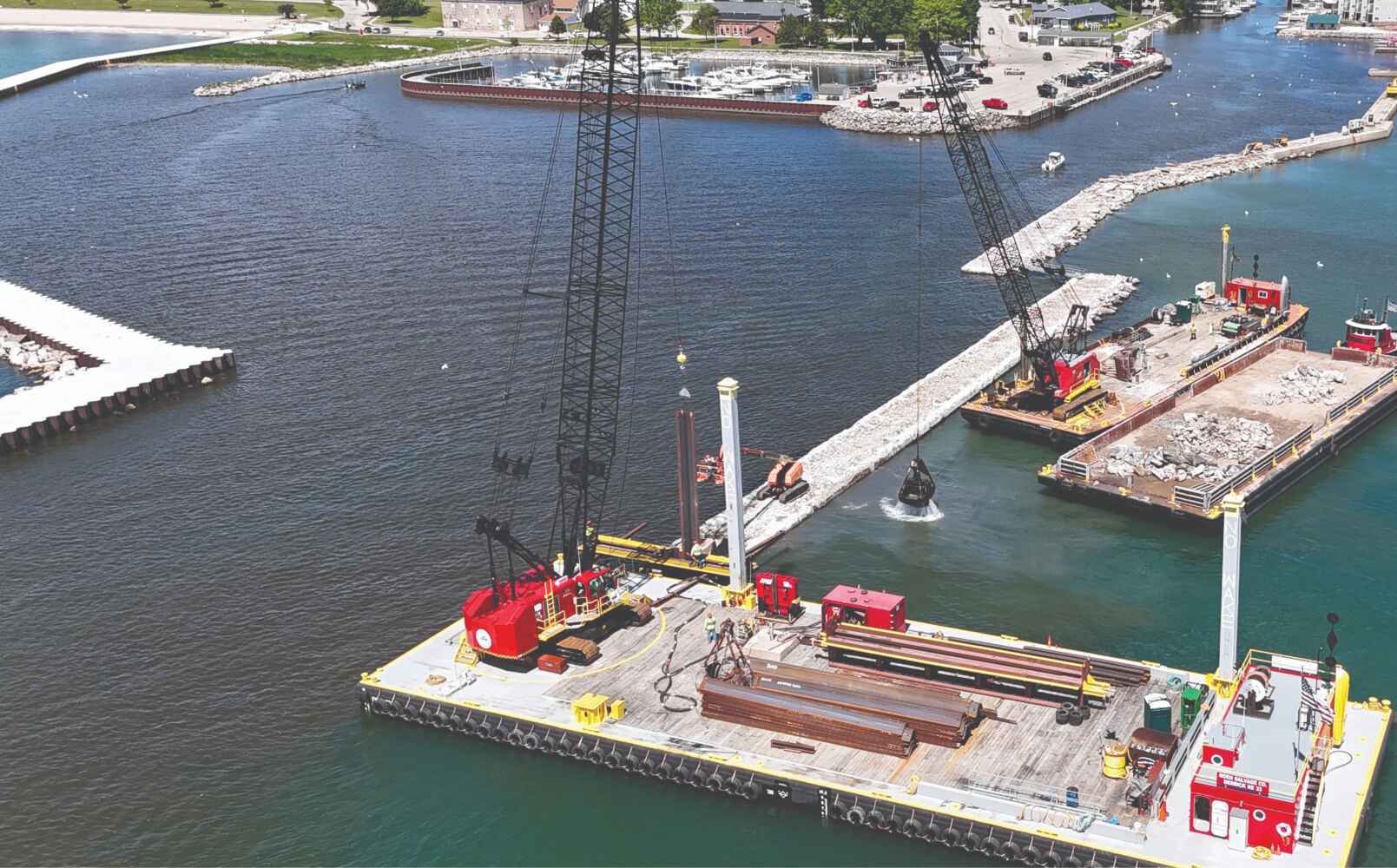
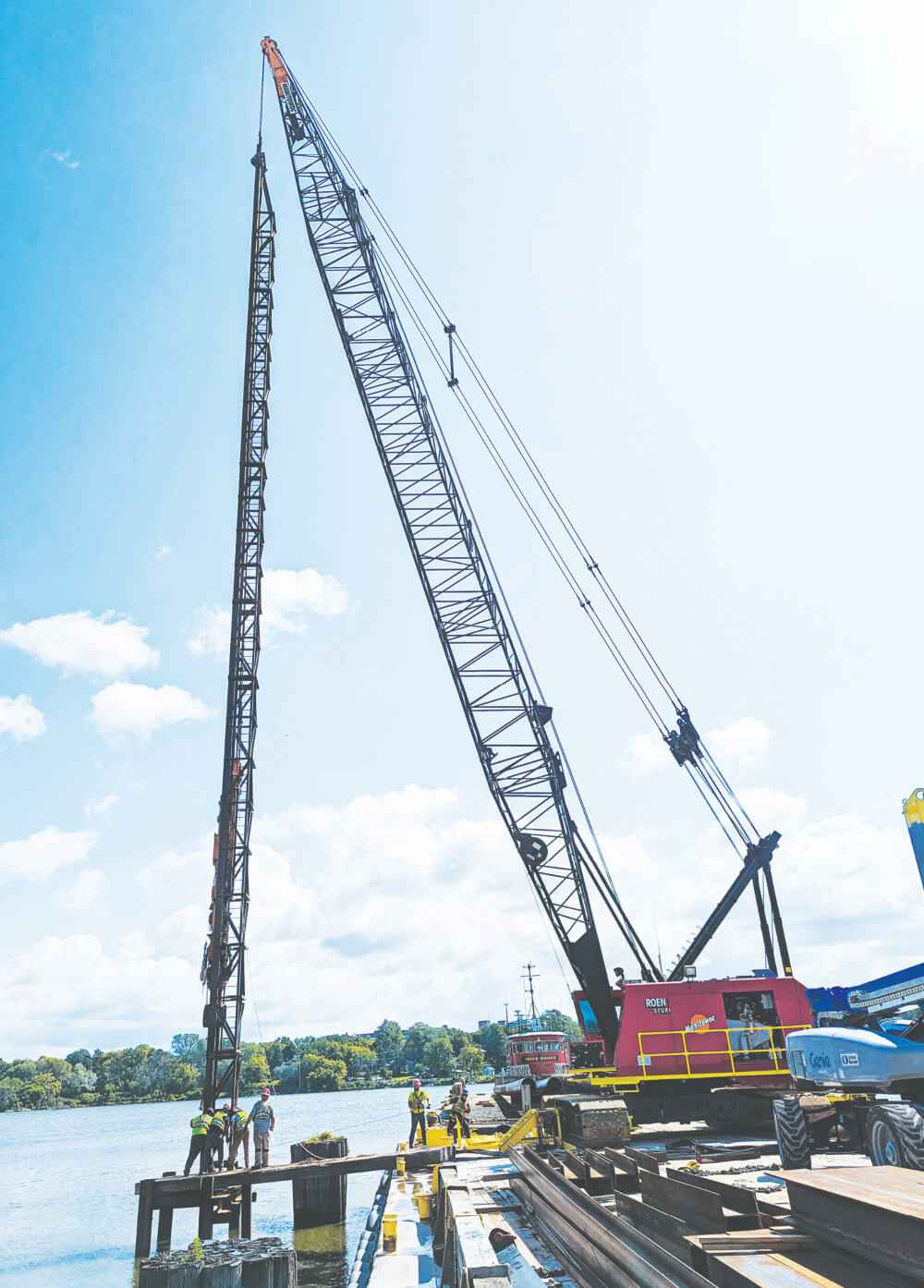
In June, Roen Salvage Company, expanded its lifting capability by adding a Lampson Millennium 4100 lattice-boom crawler crane to its fleet.
Lampson International creates the 230-ton capacity Millennium model by upgrading a Manitowoc 4100W with hydraulic drive for all functions, new hoisting drums, electronic controls and a comfortable modern operator’s cab.
Lampson has designed and tested the Millennium 4100 to comply with the ANSI/ASME B30 code and provides a Lampson capacity chart for the machine.
“The Millennium crane brings together the rugged structure of the 4100 with the most modern operating technology,” said Barry Kuzay, vice president and general manager of Roen Salvage. “That combination is perfect for the demanding marine construction work Roen does.”
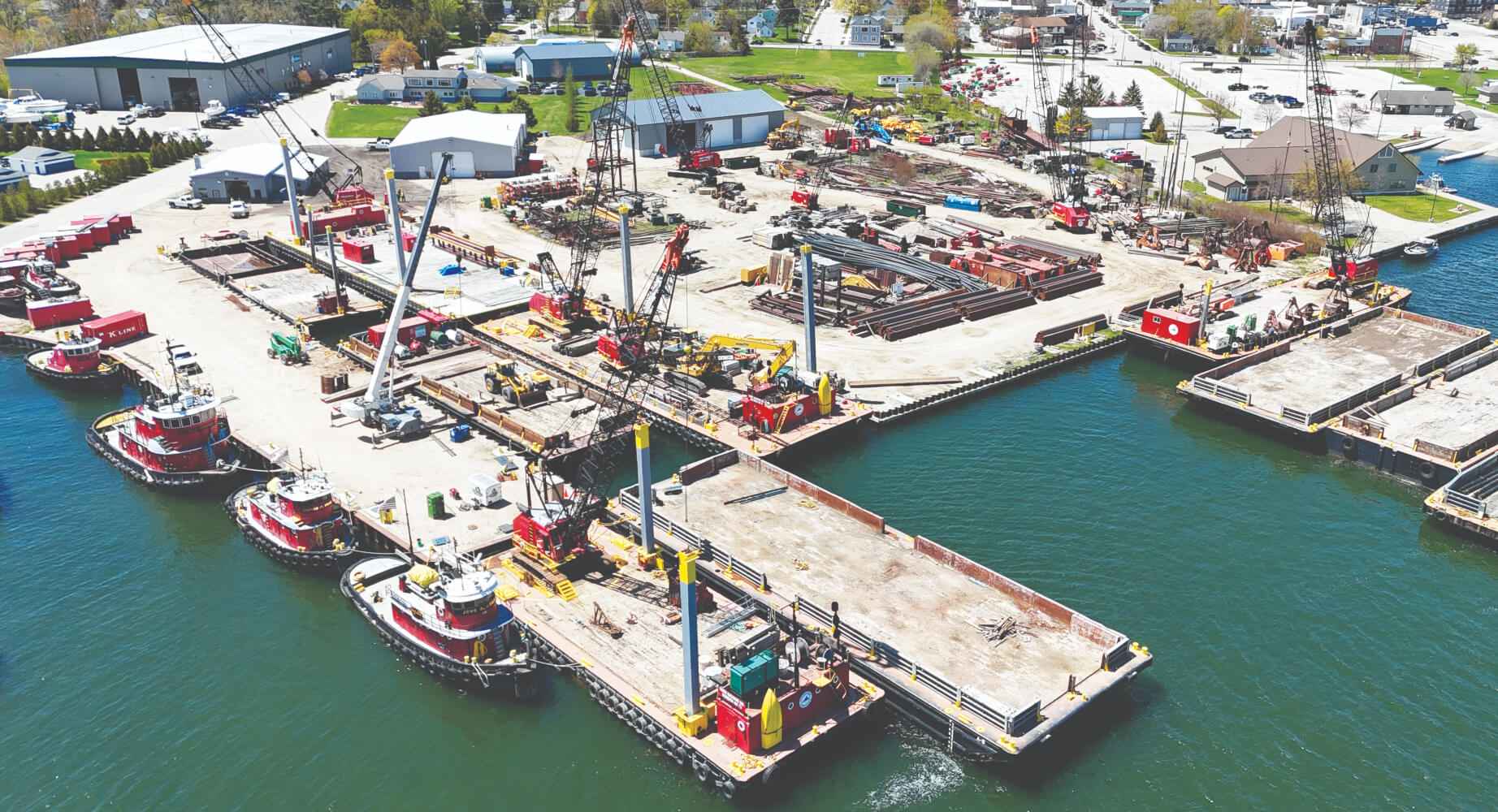
The Millennium 4100 joins six rugged older Manitowoc cranes that have been serving Roen reliably for decades.
They include a 75-ton 3000W, two 115-ton 3900s, a 130-ton 3900W, a 150-ton 3950W and a 175-ton 4000W.
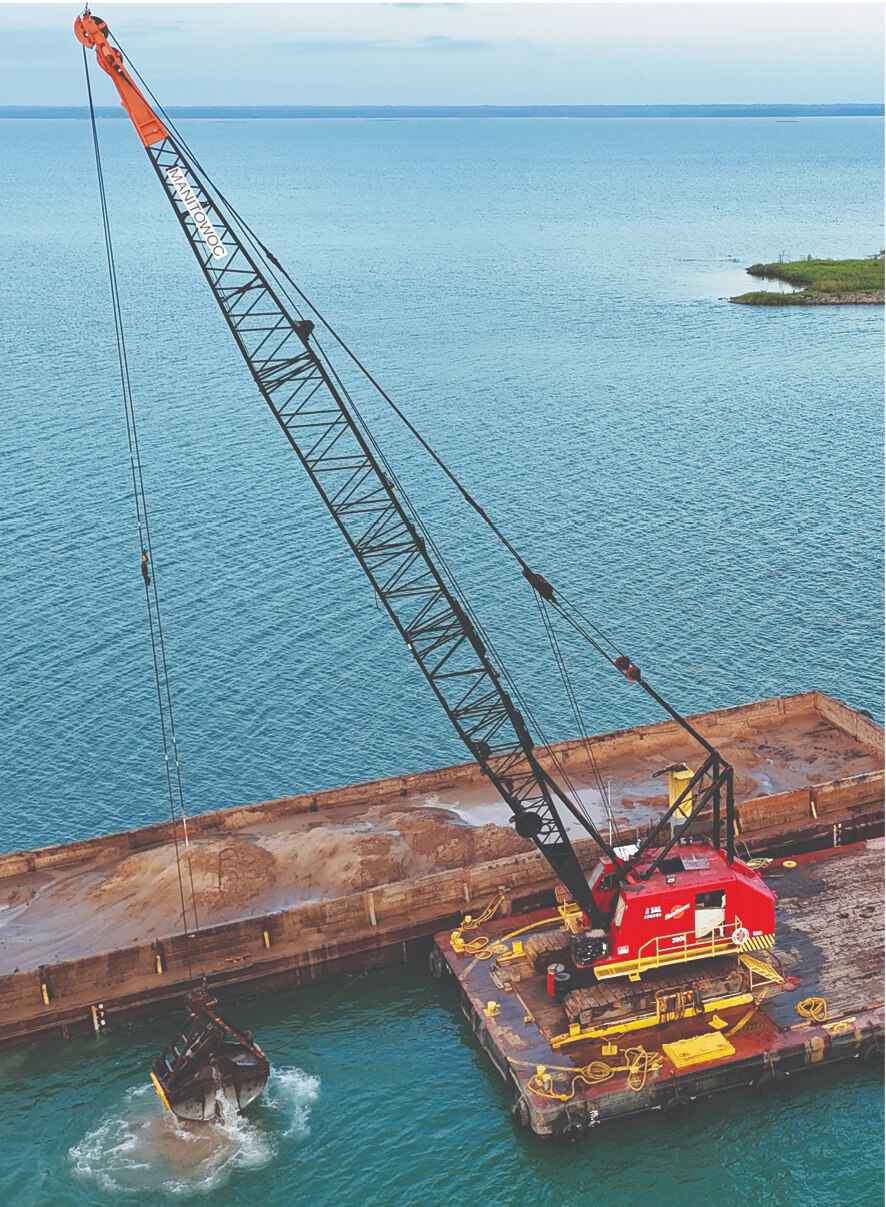
Roen’s crane fleet also includes a 70-ton Terex RT775 rough-terrain crane that it uses as a cherry picker and a 40-ton American 4210 lattice boom crawler crane.
One reason those older cranes keep working reliably for Roen is the strength that was built into them when they were manufactured decades ago.
Another is Roen’s attentive care, which keeps them in top shape and carefully refurbishes them each winter, when Great Lakes ice, snow, wind and sub-zero temperatures make marine construction impossible.
The Manitowocs and the Lampson all are set up primarily to do duty-cycle work.
Typical tasks include dredging, offloading dredgings, placing armor stone and driving sheet or pipe piles.
On a typical project, Roen’s cranes make hundreds of picks per day, and many of the jobs run nonstop 24 hours a day.
Legacy Rigs Ideal for On-Barge Marine Work
It’s not surprising that Roen has found outstanding success and value in relying on older cranes for its demanding work.
“We always move our cranes by barge, and they almost always work from barges, so we aren’t concerned about highway shipping weights,” said Kuzay.
“When choosing a crane, we look for duty cycle capabilities and a sturdy build,” he said. “Modern cranes are designed to minimize operating weight for more economical truck shipment, so they have a long tail swing to get the needed stability.”
Kuzay explained why long tail swing is a disadvantage on a barge. “It eats up the usable deck space, creates pinch points and causes the barge to list more, even if you aren’t lifting anything heavy,” he said.
Kuzay added that he believes the structural designs of older cranes makes them the right choice for Roen’s demanding work.
“On barges, you need a crane that can handle some degree of list and trim,” he noted. “Old Manitowocs can do that even under duty-cycle frequency. That’s why we rely on them.”
A second reason for Roen’s success with older cranes is how well the company takes care of them.
“All of our crane operators are trained in house and promoted from within,” Kuzay said. “They all have to learn to be crane mechanics before they can become NCCCO-certified operators. Having operators that aren’t just pulling magic levers helps greatly, both with safety and with preventive maintenance.”
Besides performing regular maintenance on all of its cranes during the construction season, Roen does extensive work in its shop during winter.
That work typically includes overhauling one or two cranes each year.
The overhaul process includes installing new torque converters, attending to other major parts that need machining or replacement and checking over the entire rig for structural integrity.
A Step Up
Roen bought the Millennium 4100 to provide higher lifting capacity along with the easy operation, precise control and smooth performance offered by today’s hydraulic power transmission and electronic controls.
“We were encountering projects more often that were nearing the limits of our 150-ton cranes,” said Kuzay. “The Millennium’s 230-ton capacity lets us do those more-demanding jobs. We even had a new 180-foot by 60-foot barge built mainly for that crane.”
Kuzay, a licensed professional engineer, said that Roen chose the Millennium 4100 because it is reliable, easy to operate and maintain and fit the company’s budget.
“The Lampson Millennium is much simpler than either an old friction crane or a new hydraulic model, and it’s priced right,” he said.
“Also, as a family-owned company, Roen is proud to do business with another family-owned company in Lampson,” Kuzay added.
Though Roen bought 180 feet of boom for the Millennium 4100, Kuzay says he expects it to work most often with 120 feet. “For all of our cranes, that boom length is the most typical, and we never use jibs,” he said.
Roen is also using the Millennium 4100’s full, Series-2 counterweight for maximum stability, which brings the crane’s operating weight to about 460,000 pounds.
Thanks to the Millennium 4100’s versatility, Roen plans to keep it busy doing a variety of work.
“We expect to mainly use it to drive pile and construct breakwaters,” said Kuzay. “It will also do our heavy lifts, like the recent relocation of the Algoma lighthouse, a 100,000-pound pick on 140 feet of boom.”
Long History,Strong Reputation
Roen Salvage Company is a heavy civil marine contractor that is headquartered in Sturgeon Bay, Wisconsin.
Founded in 1949 by Charles W. Asher and Hilda Roen Asher with help from Hilda’s father, Captain John Roen, Roen Salvage is now led by the family’s third generation in the business, CEO John Roen Asher.
During more than 75 years of serving customers throughout the Great Lakes and midwestern inland waterways, including the Mississippi River, Roen has built a strong reputation for integrity and high-quality professional work.
The company specializes in marine construction, dredging and environmental remediation.
Its wide-ranging services include driving pile; dredging; building breakwaters, navigation lights, submarine pipelines and steel sheet-pile walls; repairing and rehabilitating steel sheet-pile dock walls; doing underwater blasting and marine demolition; running submarine power cables; performing hydrographic surveys and doing many other kinds of marine work.
Roen’s typical clients include the U.S. Army Corps of Engineers, private commercial dock owners, the U.S. Coast Guard and state and municipal governments.
The company has about 40 full-time employees, many of whom have been with Roen from 10 to 30 years.
Nearly all of those workers are skilled in multiple construction trades that range from welding and rigging, to framing, concrete work, installing mechanical gear and operating heavy equipment.
“The same crew can do a whole project from start to finish,” said Kuzay.
He noted that the company has about a dozen licensed crane operators, who work as part of the crew when they are not in the seat pulling levers. “We don’t always need all of them operating at once, but each operator is multi-talented and performs other work when they aren’t in the crane,” he said.
Kuzay added, “We are always looking for highly talented employees who are interested in learning multiple skills. We offer paid training and upkeep of certifications.”