
Carry Deck Crane Market Shows Steady Growth Through 2035
Fact.MR forecasts steady growth for the carry deck crane market, with North America driven by industrial maintenance, construction and rental demand.
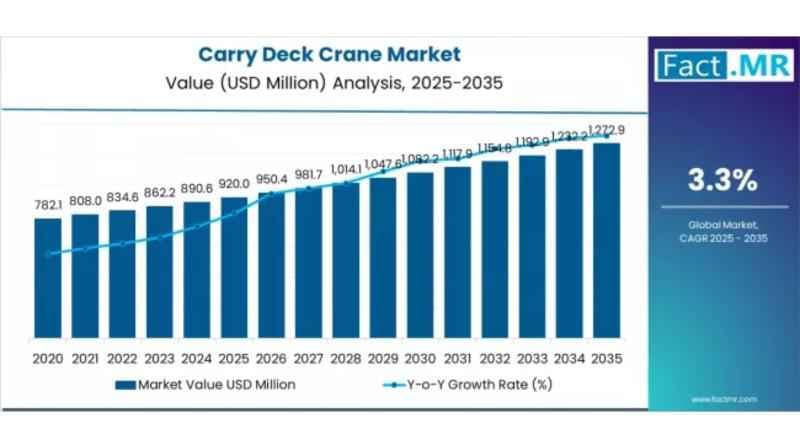
A new market outlook from Fact.MR projects steady growth for the global carry deck crane market over the next decade, driven by demand for compact lifting equipment in industrial, construction and maintenance environments. While growth is occurring worldwide, North America remains a key mature market supported by industrial activity, refinery maintenance and equipment replacement cycles.
According to the report, the carry deck crane market is expected to grow from $920 million in 2025 to approximately $1.27 billion by 2035, representing a 38% total increase and a compound annual growth rate of 3.3% during the forecast period.
Carry deck cranes are characterized by their low-profile design, 360-degree rotation and ability to lift and transport loads within confined spaces, making them suitable for applications where larger mobile cranes are impractical.
North America Remains a Core Market
The United States and Canada are identified as established markets for carry deck cranes, supported by a strong industrial base, refinery and plant maintenance activity and a well-developed rental equipment sector. The report notes that replacement demand and technology upgrades continue to drive sales in the region, particularly as operators look to improve safety and efficiency.
Demand Driven by Industrial Maintenance and Construction
Fact.MR points to increased maintenance, repair and overhaul activity across sectors such as oil and gas, power generation and heavy manufacturing as a primary demand driver. Carry deck cranes are frequently used during plant shutdowns and turnarounds, where their mobility allows loads to be lifted and transported without additional material-handling equipment.
Construction activity is also contributing to demand, especially on congested job sites where access limitations restrict the use of larger cranes. Carry deck cranes are often used for material handling in tight spaces on commercial and industrial projects.
Capacity and End-Use Trends
The report segments the market by capacity and application. Carry deck cranes rated between 10 and 20 tons represent the largest share, particularly for general industrial maintenance. Smaller units below 10 tons are commonly used indoors, while cranes above 20 tons are applied in heavier industrial and infrastructure projects.
By end use, manufacturing and industrial plants account for the largest share of demand, followed by oil and gas, construction and rental services. Rental fleets are increasingly adopting carry deck cranes to meet short-term project needs across multiple industries.
Market Challenges Remain
Despite steady growth, the report identifies several challenges, including limited awareness in some markets, higher upfront equipment costs compared to simpler lifting solutions and the need for skilled operators. Competition from alternative compact lifting equipment, such as telehandlers and mini cranes, also continues to influence purchasing decisions.
Competitive Landscape
The carry deck crane market is described as moderately consolidated. Manufacturers are focusing on durability, safety features and after-sales support while expanding dealer networks and rental partnerships. Companies cited in the report include Broderson Manufacturing Corp., Manitex International, Tadano Ltd., Konecranes and Load King Manufacturing.
Fact.MR concludes that carry deck cranes will continue to play a role in material-handling fleets as industries seek efficient lifting solutions for space-constrained environments through 2035.
As demand for carry deck cranes continues to rise, Crane Hot Line’s Job Board connects employers with qualified crane operators, technicians and industry professionals to help support the workforce needs driving this growth.