Circling North America
Berard Transportation executes 8,842-mile crane delivery
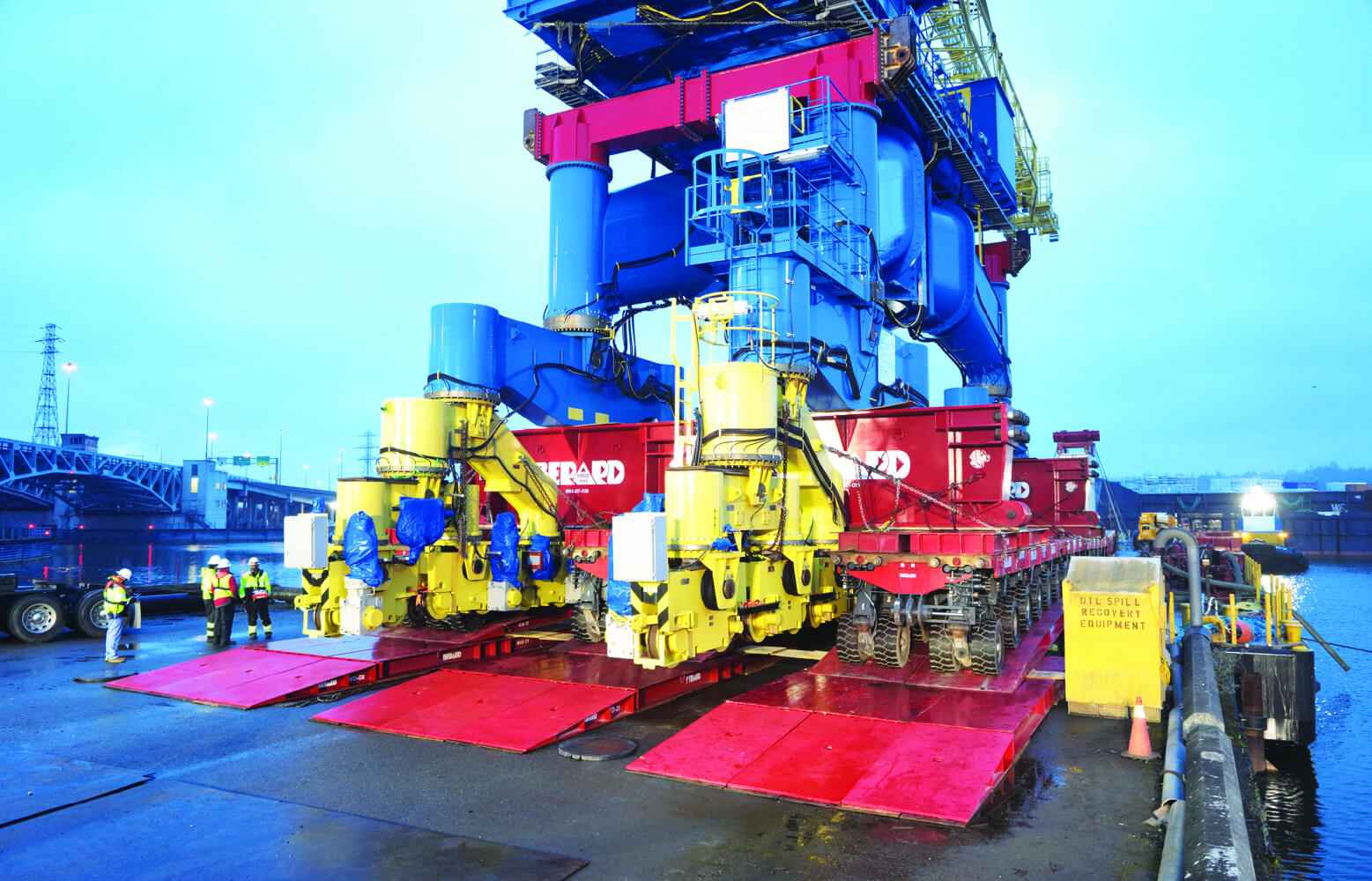
Berard Transportation Company recently designed, engineered and managed every facet of barging a huge shipyard crane from Manitowoc, Wisconsin, to Seattle, Washington.
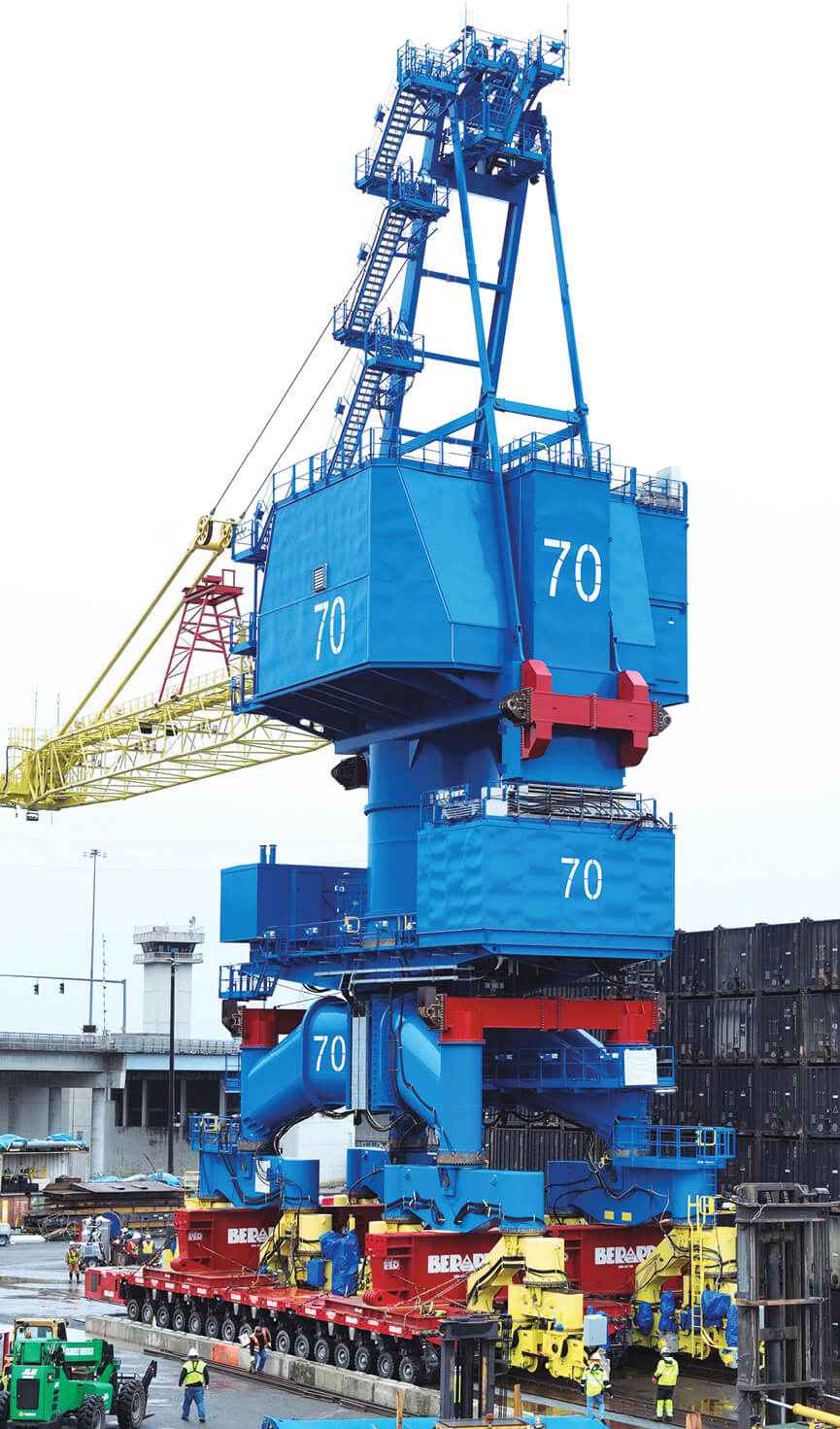
The impressive single-boom portal crane, called “Big Blue 70,” weighs 1,200 tons, stands 155 feet tall and can lift 175 tons.
After Big Blue has been tested and certified at a shipyard in Seattle, Berard will barge it about 21 miles to the Puget Sound Naval Shipyard in Bremerton, Washington, where it will help maintain submarines, including future Columbia-class models.
Big Blue was designed and sold by Konecranes and manufactured for Konecranes by Wisconsin Heavy Fabrication.
Though Wisconsin Heavy Fabrication has no connection with The Manitowoc Company, it sits on the same site where Manitowoc built submarines during World War II and manufactured cranes for decades after that.
Challenging Project
Konecranes chose Berard to design and manage Big Blue’s transportation from Wisconsin to Washington state based on the heavy-haul transport company’s 80 years of experience, full range of capabilities and proven performance.
“Last year, we moved four 25-ton portal cranes for Konecranes,” said Berard Transportation’s Chief Operating Officer, Braedon Berard. “Our success on those jobs led Konecranes to rely on us for this one.”
On this move, Berard was responsible for planning, engineering and executing every aspect of the project.
It selected the sailing route from Manitowoc, through the Great Lakes, Soo Locks, Welland Canal and St. Lawrence Seaway to the Atlantic Ocean, down the entire East Coast of the U.S., west through the Gulf of Mexico, Caribbean Sea and Panama Canal and north up the Pacific Coast of Central and North America to Seattle.
Berard checked the width, depth and height clearances for every bridge, canal, lock and other potential sticking point along the entire 8,842-mile voyage.
It also chose the towing company that would provide the barge, tugs and maritime crews to transport the crane on the four-month voyage.
In addition, Berard and a third-party expert both calculated barge and crane stability, which enabled Berard to specify the wind and wave limits that were safe to sail in.
If wave heights or wind speeds exceeded the limits, the tugs and barge needed to seek safe harbor.
Beyond the route and sea planning, Berard was responsible for specifying the size, capacity and stability of the barge, and for engineering how the crane would be loaded onto it, secured in place and offloaded.
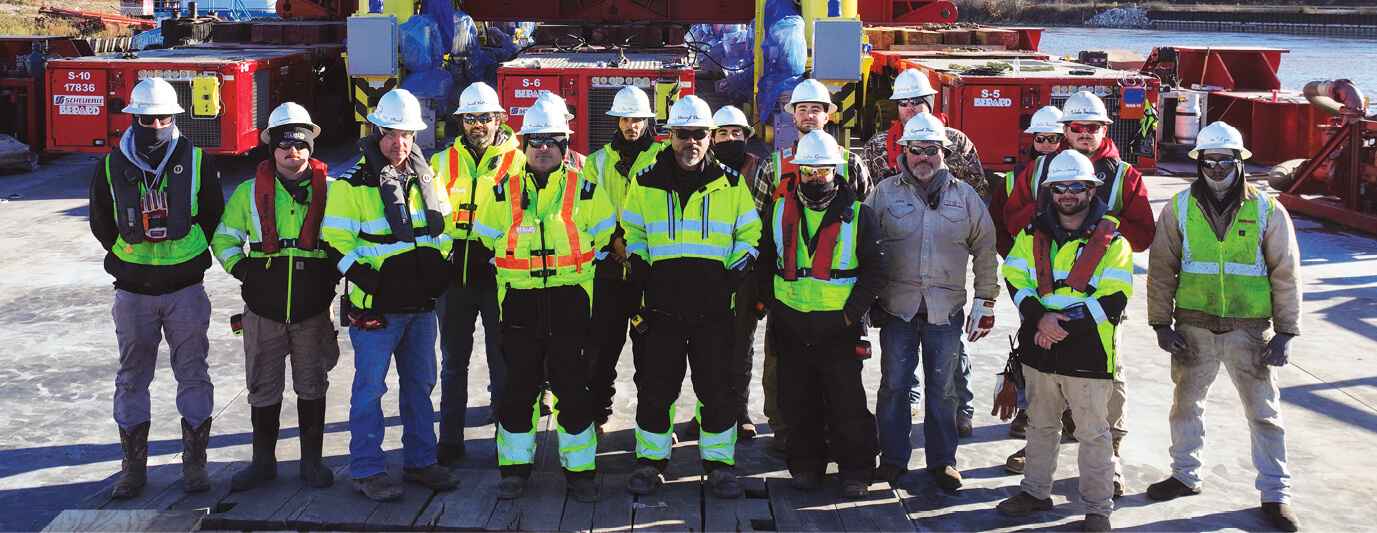
In addition, Berard crews fabricated, installed and removed the sea-fastening components and performed the on-loading and off-loading of the crane.
“All of the things we had to plan, calculate, arrange and do are pretty routine for us,” said Berard. “The challenge was doing them quickly so the tugs and barge could sail by mid November, just two and a half months after we were awarded the job.”
That timing was essential so the tugs and barge could travel through the St. Lawrence Seaway before it closed for winter.
Selected Barge and Tugs
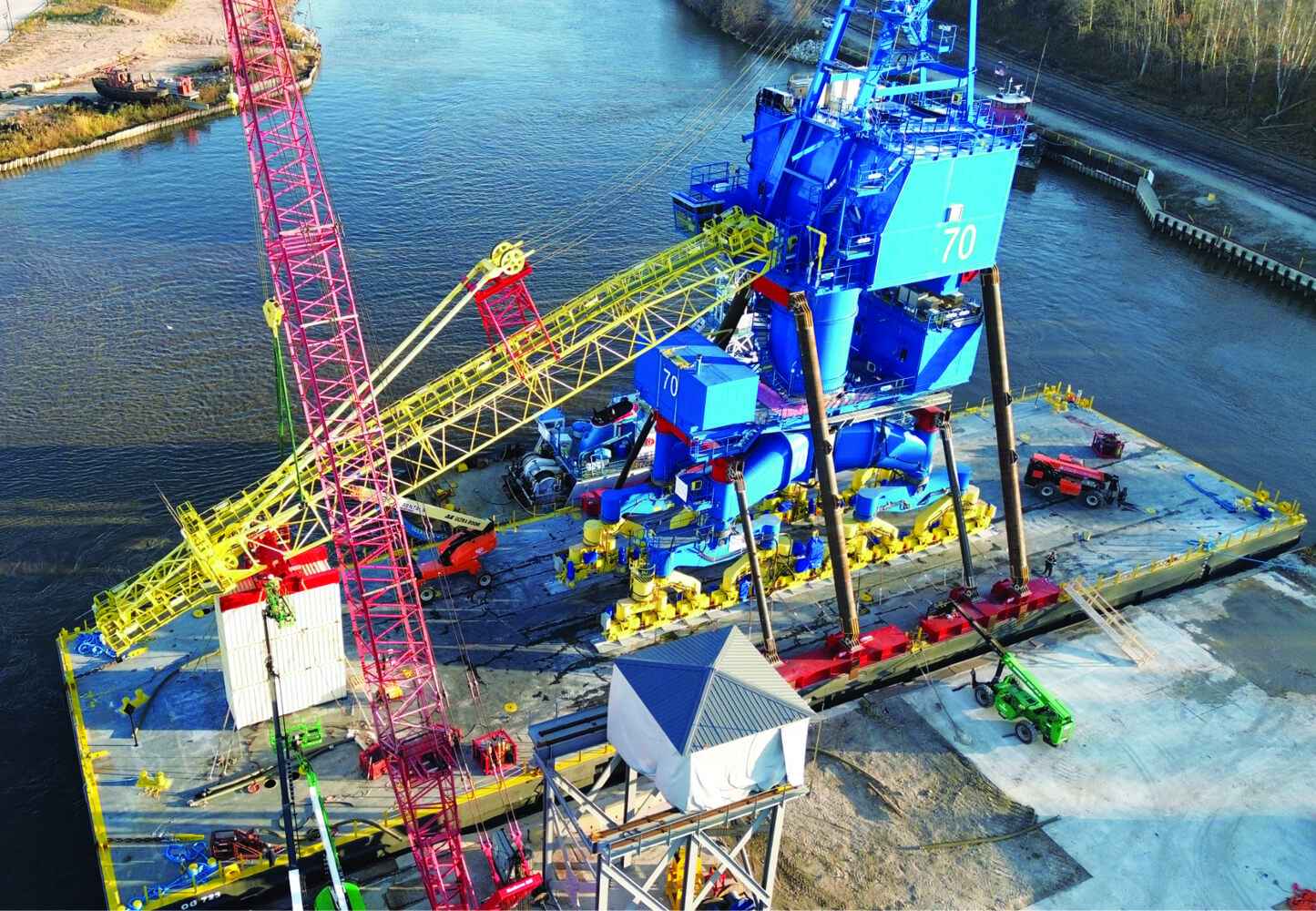
The Big Blue crane measures 197 feet long, 45 feet wide, 155 feet high, weighs 1,200 tons and has a high center of gravity, so Berard specified a barge that was big, strong and buoyant enough to remain stable in a variety of sea conditions.
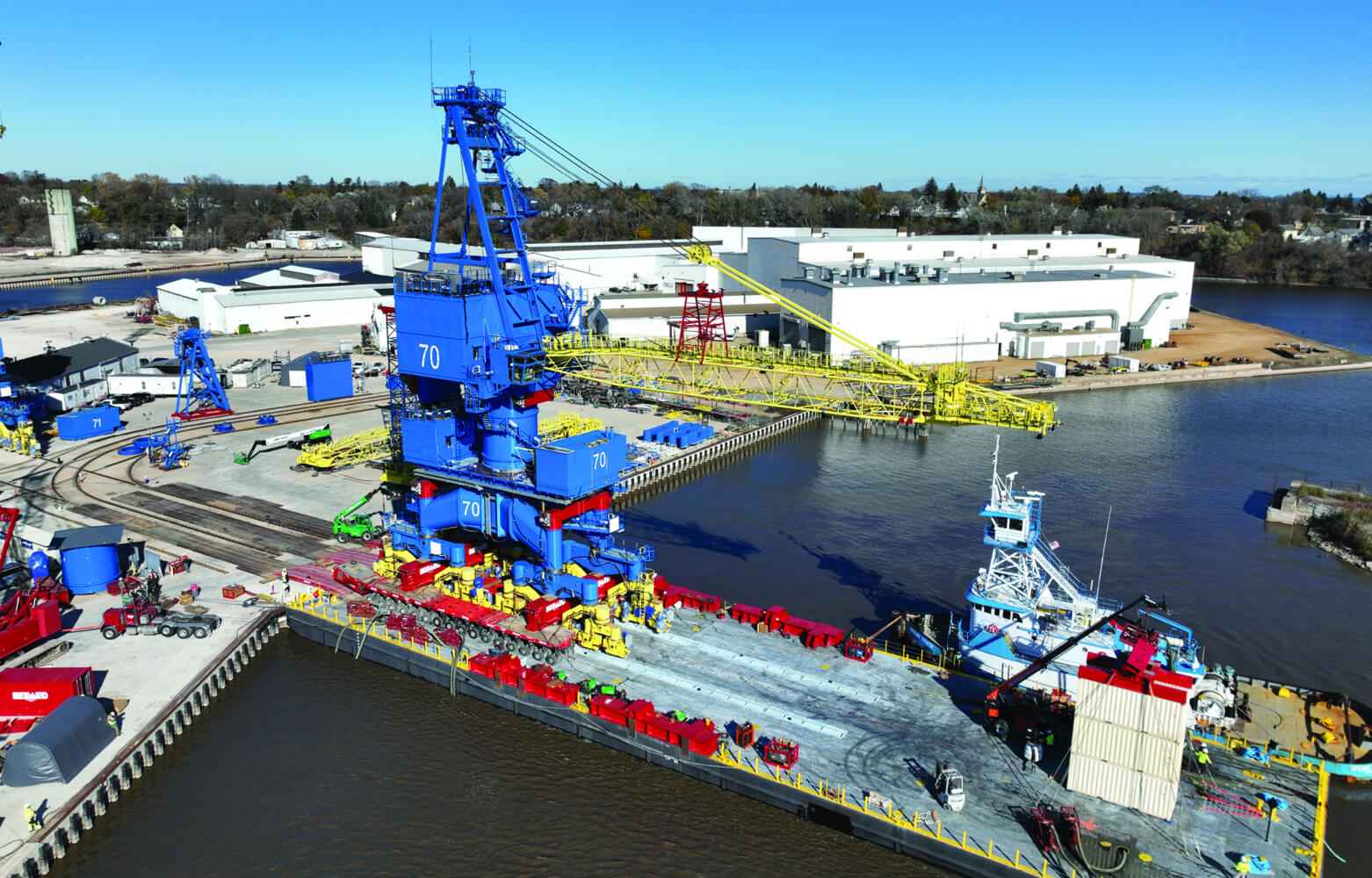
That barge, the OG723, owned by SEA OG, measured 260 feet long, 72 feet wide and 16 feet deep — large enough to support the crane, yet narrow enough to comply with the St. Lawrence Seaway’s 78-foot width restriction.
The primary tug on the project was the 4,080-horsepower Ocean Tower, owned by Dann Ocean Towing. It did all of the towing.
The assist tug was McKeil Marine’s 2,000-horsepower Jarrett M, which helped maneuver the barge when needed.
Smooth Roll On
Berard rolled the crane onto the barge and positioned it using 48 axle lines of self-propelled modular transporters (SPMTs), and two modular beam systems (MBS).
All the components came from Berard’s inventory and were used in a configuration that Berard engineered specially for this job.
The SPMTs were all Scheuerle four- or six-axle units, each with 48-ton capacity, all-wheel steering and hydraulic leveling.
The SPMTs were arranged in three parallel files, each consisting of two six-axle modules and one four-axle.
Each file was powered by its own portable power pack mounted at one end.
One file of SPMTs ran along the left side of the crane’s base, a second file ran directly under the center of the crane and a third file ran along the right side of the crane’s base.
Sitting perpendicular across the three files of SPMTs were two of Berard’s MBS modular beams, each 40 feet long.
The two beams spread the crane’s weight evenly to all three files of SPMTs.
The control and hydraulic systems of all nine SPMT modules were interconnected so that all of them traveled together and all 48 axles steered in unison, thanks to a Berard-created computer program.
As a result, one operator controlled all nine SPMT units as though they were a single transporter.
The loading was done according to Berard’s engineered sequence.
First, the Berard crew prepared the barge by fastening tracks to the deck for the crane’s railroad-type wheels to sit on during the voyage and by welding down beams for the sea-fastening system that would hold the crane securely in place.
Then the pin-connected sections of the two Berard MBS modular support beams were assembled under Big Blue and the SPMTs were installed beneath them.
When the barge had been ballasted to dock level, the crew laid ramps from the dock to the barge for smooth travel.
The SPMT decks were raised hydraulically to lift the crane, and the SPMTs rolled onto the barge carrying Big Blue.
When the crane was in the exact position specified by Berard’s barge-stability calculations, the SPMTs lowered the crane until its wheels engaged the rails that had been welded to the barge deck.
Then stands with rollers were pinned to the ends of the MBS beams to support them, and the SPMTs were driven off the barge before the beams were rolled off the barge by a forklift and a crane.
To support the crane’s 135-foot boom, Berard stacked three shipping containers and mounted a custom-made connector on top.
The Berard team then used tape and drone measurements to verify the crane’s position was correct, both for stability and so that the sea-fastening system’s pipes would align and support the crane properly.
Strong Sea-Fastening Vital
To hold Big Blue upright and stationary through four months of winds and waves, Berard engineered and manufactured a strong sea-fastening system.
The system’s most visible components were four pipes that braced each side of the crane to supports welded to the barge deck.
Pipes supporting the crane’s upper structure were 36-inch diameter. Pipes supporting the crane’s lower section were 20-inch diameter.
All of the pipes connected to the crane and deck supports with pins. That let all eight be installed or removed in a couple of hours.
The sea-fastening system’s other components were stopper plates between the barge deck and crane wheels, chains with tighteners holding the crane’s bogies to the barge and the connector on the crane’s boom rest.
“One of this project’s biggest challenges was designing the sea-fastening,” said Berard. “It had to be strong and durable for open-ocean travel. We designed it to DNV standards for unrestricted weather criteria.”
After the crane had been secured to the barge, Berard trucked the nine SPMTs, two MBS modular beam systems and other essential equipment from Manitowoc to Seattle for offloading Big Blue.
Offloading Challenge
The procedure for offloading Big Blue in Seattle was essentially the reverse of that used for loading the crane in Manitowoc, but with one big difference.
The tides near Seattle can fluctuate by 13 feet and rise or fall by 2 feet per hour.
That meant the offloading had to be done when the tide was at the right hight for the barge deck to align with the dock.
Berard developed a plan to offload within the time that the tide was right, and designed a fast ballasting system to adjust the barge level as conditions changed.
“Good planning was crucial,” said Berard. “The buoyancy of the barge had to be checked at certain tide times and for the capability of offloading at exact tides windows.”
After safely delivering Big Blue 72 to Seattle, the tug Ocean Tower, barge OG723 and the Berard team returned to Manitowoc, where they loaded an identical crane, Big Blue 82, for its voyage to a naval shipyard in Hawaii.