
Heart of the Job
The growing popularity of cranes in modular construction
Modular construction is on the rise, both in North America and worldwide.
The Modular Building Institute estimates that the annual value of modular building in the U.S. has risen from $15.3 billion in 2020 to $19.7 billion in 2025, and that it will keep growing to $25.4 billion per year by 2029.
Thomasnet.com says the worldwide value of modular construction in 2025 was $111 billion, and that it will grow at 8.2% per year to $207 billion in 2033.
That kind of investment and expected growth says that project owners, designers and builders are seeing solid benefits from modular construction.
Quality, Speed, Economy and Safety
Sometimes also called prefabricated prefinished volumetric construction (PPVC), modular construction builds major components like wall panels, complete rooms or even larger sections in a factory-like setting, then delivers them to a construction site for installation as major segments of a building.
Fans of modular construction say it saves time and cost while also improving quality and safety, compared to building a structure the traditional way — piece by piece.
The modular technique can be used to build whole structures or be combined with traditional piece-by-piece construction when a hybrid approach makes the most sense.
Thomasnet.com says studies show modular construction can reduce construction-site manpower by up to 40%, shorten project timelines by up to 50% and reduce cost by up to 20%.
That’s because the modules are manufactured off site in controlled facilities using repeatable processes that can be fine tuned for quality, productivity and economy.
Modular construction also improves efficiency, productivity and safety on the construction site because it reduces congestion, the number of workers and the amount of equipment working there.
Picking Right Crane is Essential
But because modules are picked off delivery trucks and set in place when they arrive, the crane or cranes that are on the job must be reliable and selected carefully.
“With modular construction, there is often only one crane per building, so the crane is the heart of the project,” said Joseph Patton, North American sales manager for tower crane manufacturer Comansa.
Fortunately, the process of choosing the right crane in modular construction is the same as for traditional methodsof construction.
As with any project involving a crane, picking one that fits the available space and delivers the needed capacity, horizontal reach and lifting height is essential.
Depending on a job’s requirements, the best crane could be a lattice-boom or telescopic-boom crawler crane, an all-terrain, a rough-terrain, a truck crane, a T-type or luffing-boom tower crane or even some combination of cranes.
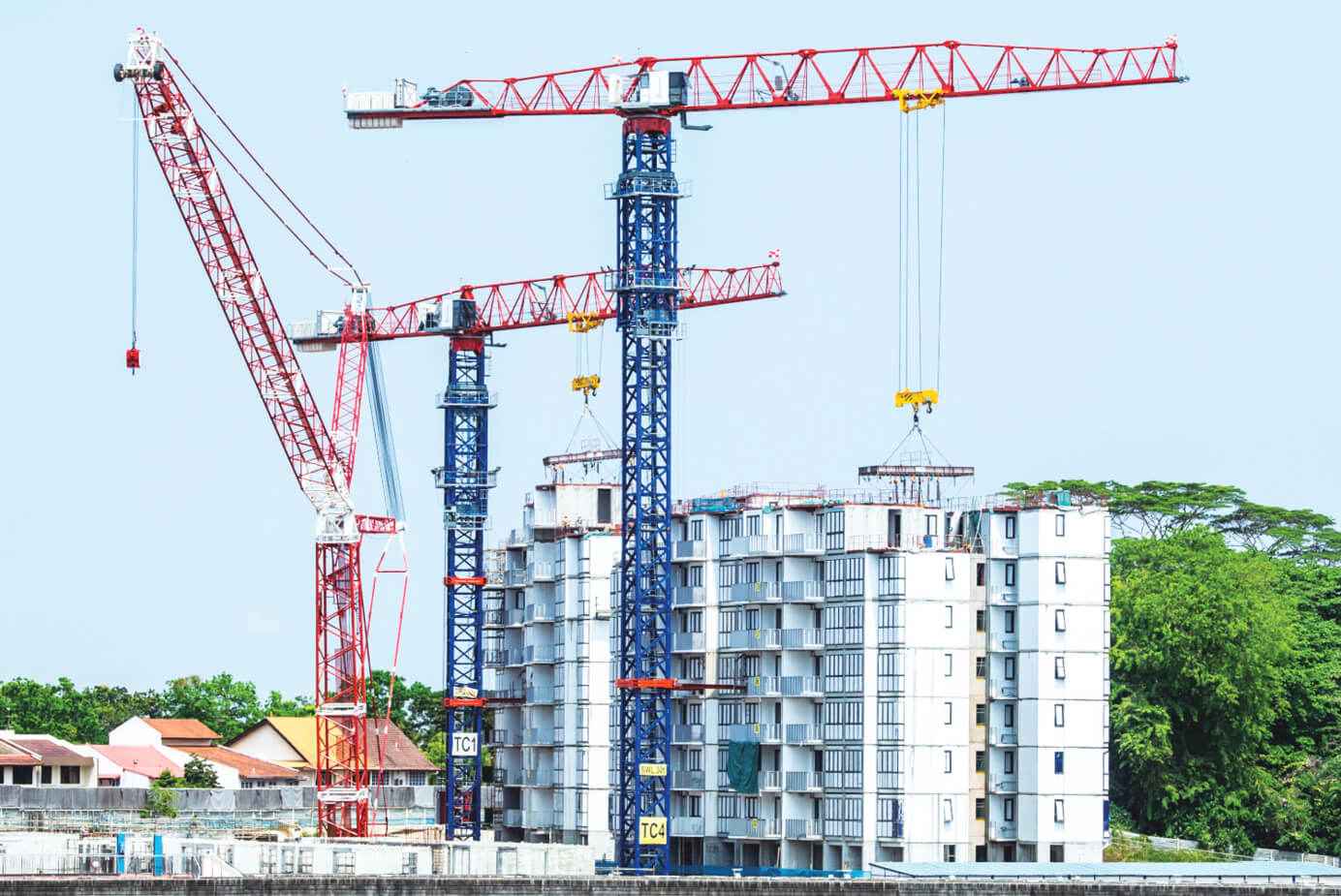
Patton said that as construction modules grow larger and building heights rise higher, tower crane manufacturers are rolling out models with more reach and capacity to meet the need.
“Today, many tower crane manufacturers offer models with maximum capacities of more than 40 U.S. tons, and in some cases 70 U.S. tons, or more,” said Patton.
Besides just weighing more, larger modules often also present challenges in motion control.
That’s where below-the-hook load controllers can help.
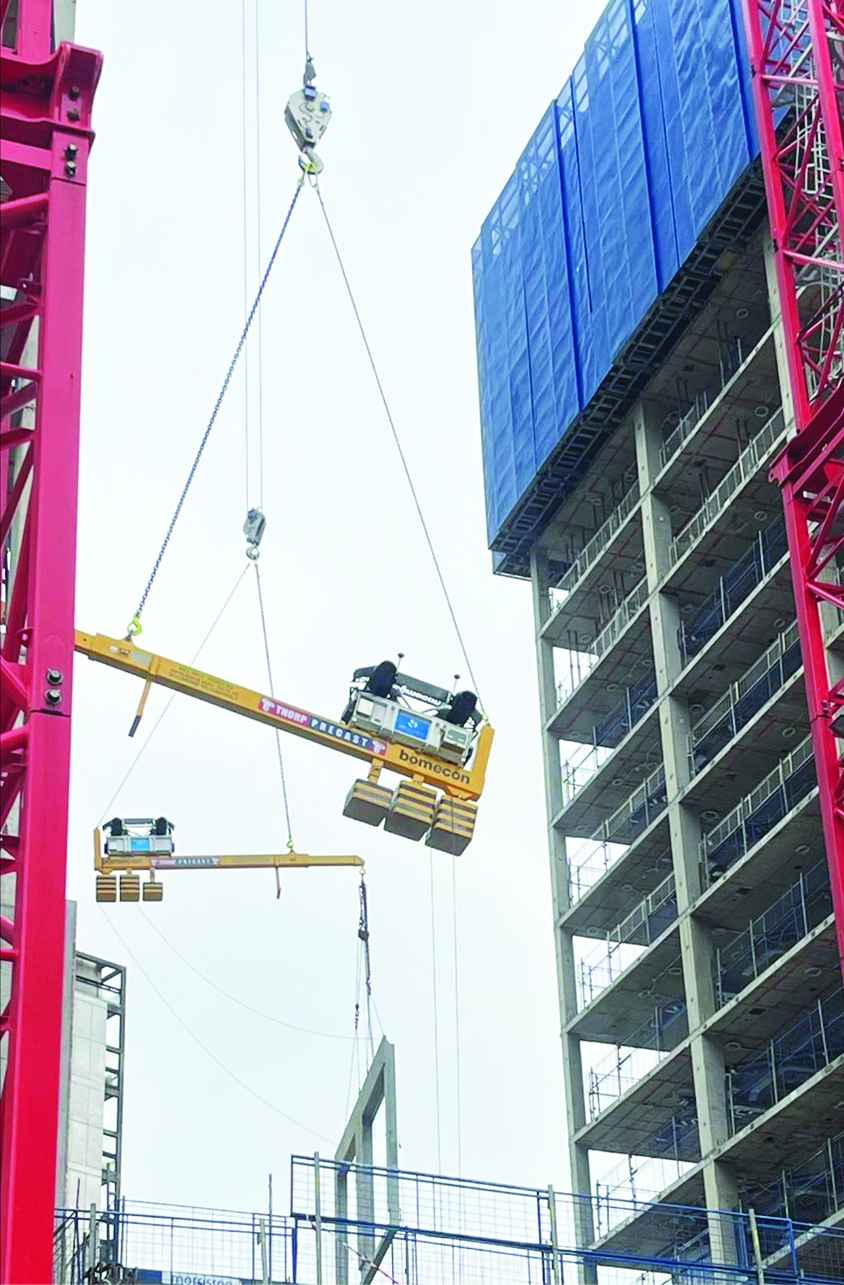
“As modules and panels become heavier and more geometrically complex, they see increased wind loading and rotational instability,” said Caleb “Rosie” Rosenberger, global account manager who leads product training at Vita Industrial, maker of the Vita Load Navigator.
The Load Navigator is a wirelessly controlled, battery-powered below-the-hook device that uses high-powered fans to provide rotational control of the load and help with precise placement.
“The system monitors more than a thousand data points per second and acts to control the load rather than react after unwanted motion has started,” said Rosenberger.
In many cases, he says, that kind of device can reduce the need for taglines.
“We are seeing this become more popular in applications, from modular construction to civil projects, renewable energy, oil and gas work, facade-panel installation, transportation, high-rise construction and many others,” said Rosenberger.
Project Example
One project that shows how traditional and modular construction can work together is a new hospital going up in Chippewa Falls, Wis.
The project’s general contractor, the Boldt Company, is stick-building about 70% of the complex.
The other 30% is being supplied as finished modules manufactured off site by Bildt, a new division of Boldt that is dedicated just to making modules.
That approach allows controlled manufacturing conditions, reduces on-site congestion and improves schedule reliability so the hospital will be able to open sooner.
The modules arrive at the construction site complete with built-in plumbing, electrical, mechanical systems, fire protection, casework and final paint.
As a module arrives on site, a crane picks it off the delivery truck and sets it into place with precision.
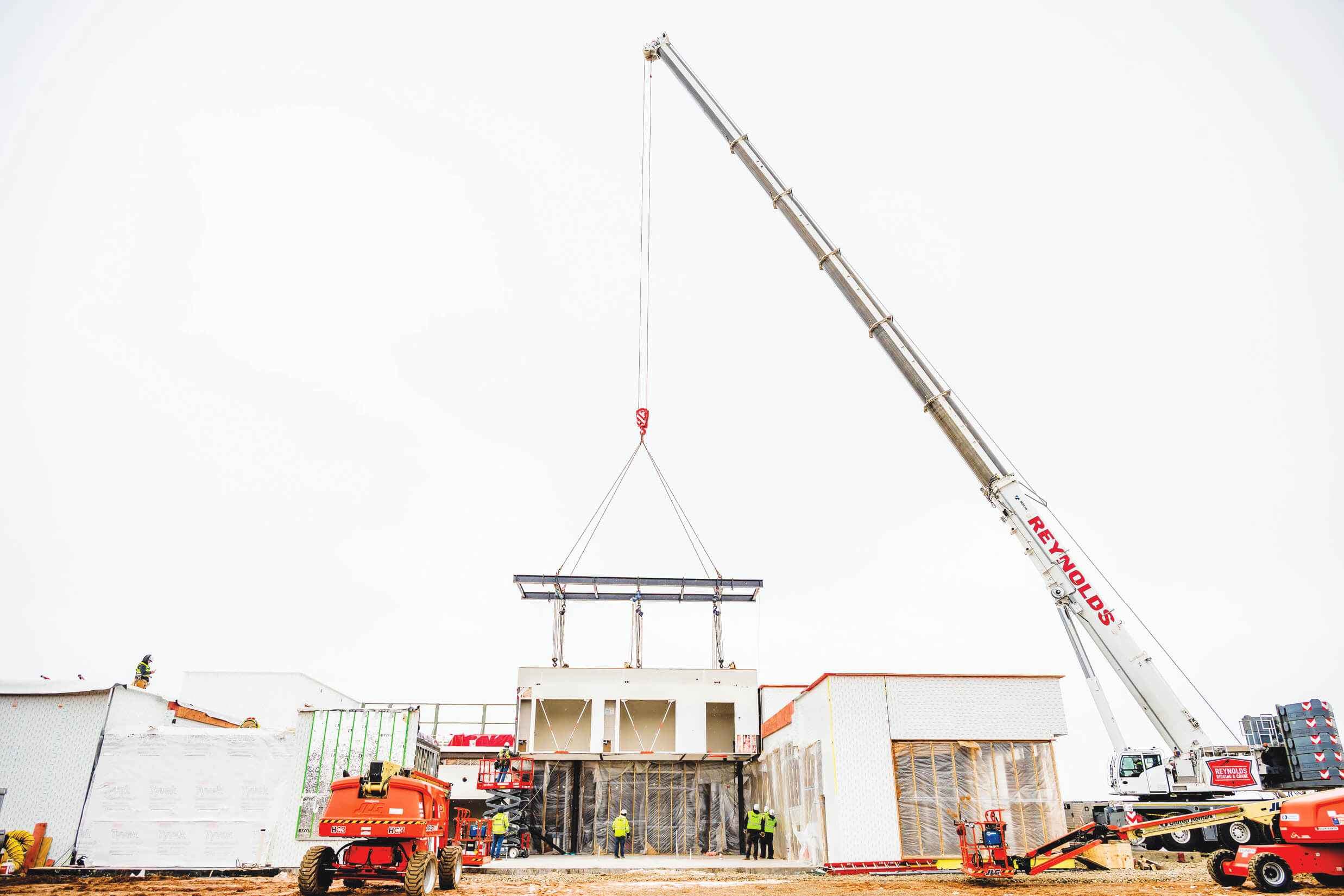
The sole crane on the job is a 500-ton Tadano AC7.450-1 all-terrain (AT) rented complete with operator from Reynolds Rigging & Crane Service.
“It’s a turnkey rental,” said Amy Marten, vice president of business development at Reynolds.
Boldt and Reynolds selected the seven-axle AT because it has the capacity to make all of the project’s lifts from one location, setting the 36,000-pound modules at radii to 110 feet on 163 feet of boom.
“That saved time and money by eliminating additional ground prep, relocation and multiple lift plan locations,” said Marten.
The new full-service medical facility is scheduled to open this September.
As construction modules grow larger and projects more ambitious, you can bet the crane industry will keep developing equipment that meets the new needs.