Shining Success
Superior Rigging and Heaton Erecting gave a metal sculpture tender care
Sometimes it’s not the size and weight of a load that presents riggers and lifters with a challenge; it’s the shape and delicacy.
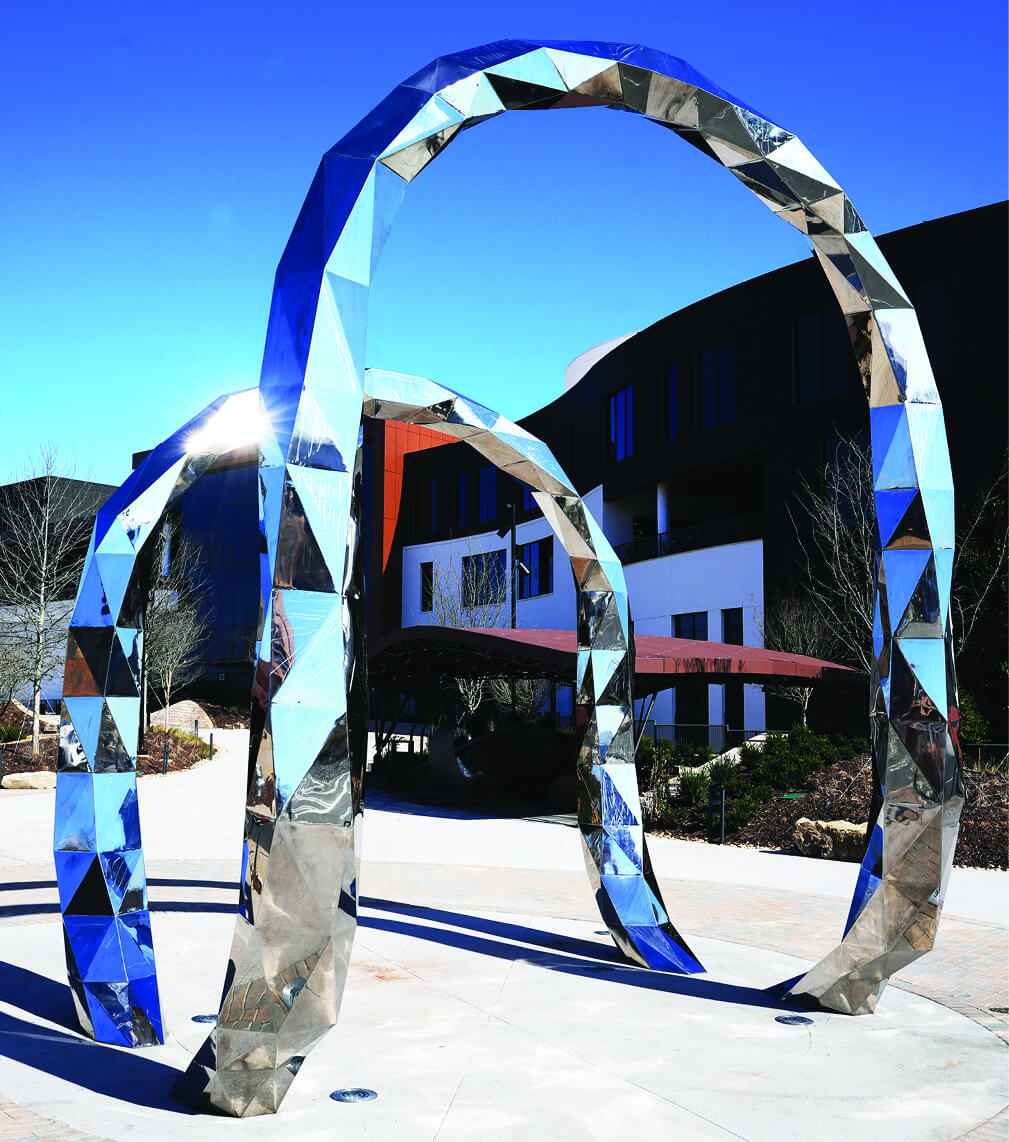
That was the case when Superior Rigging & Erecting and Heaton Erecting teamed up to transport and assemble the Beacon, a new stainless-steel sculpture that highlights a community green space in Trilith, Ga.
Created by sculptor Adam Hart, the Beacon stands as a landmark on the 51,000-square-foot plaza outside Trilith LIVE, a music and theater venue in the 235-acre, master-planned Trilith development in Fayetteville.
When the shiny new sculpture was dedicated in January, the key speaker called it “a symbol of creativity, connection and what’s ahead,” and added that it stands as a shared gathering point for the community.
Team Effort
After being friendly competitors for decades, Superior Rigging & Erecting and Heaton Erecting became one business when Superior bought Heaton in 2024.
Both companies are headquartered in metropolitan Atlanta and have long histories and strong reputations in the area.
Superior was founded in 1952; Heaton in 1966.
Although each company still operates under its own name, they often work together on projects, as they did on this one.
The Superior-Heaton team was chosen for this project based on the recommendation of one of Heaton’s satisfied repeat customers.
“Working together allows the two teams to seamlessly combine crane services, transportation and advanced rigging under one coordinated operation that benefits the customer,” said Bryant Lewis, marketing manager for the both businesses.
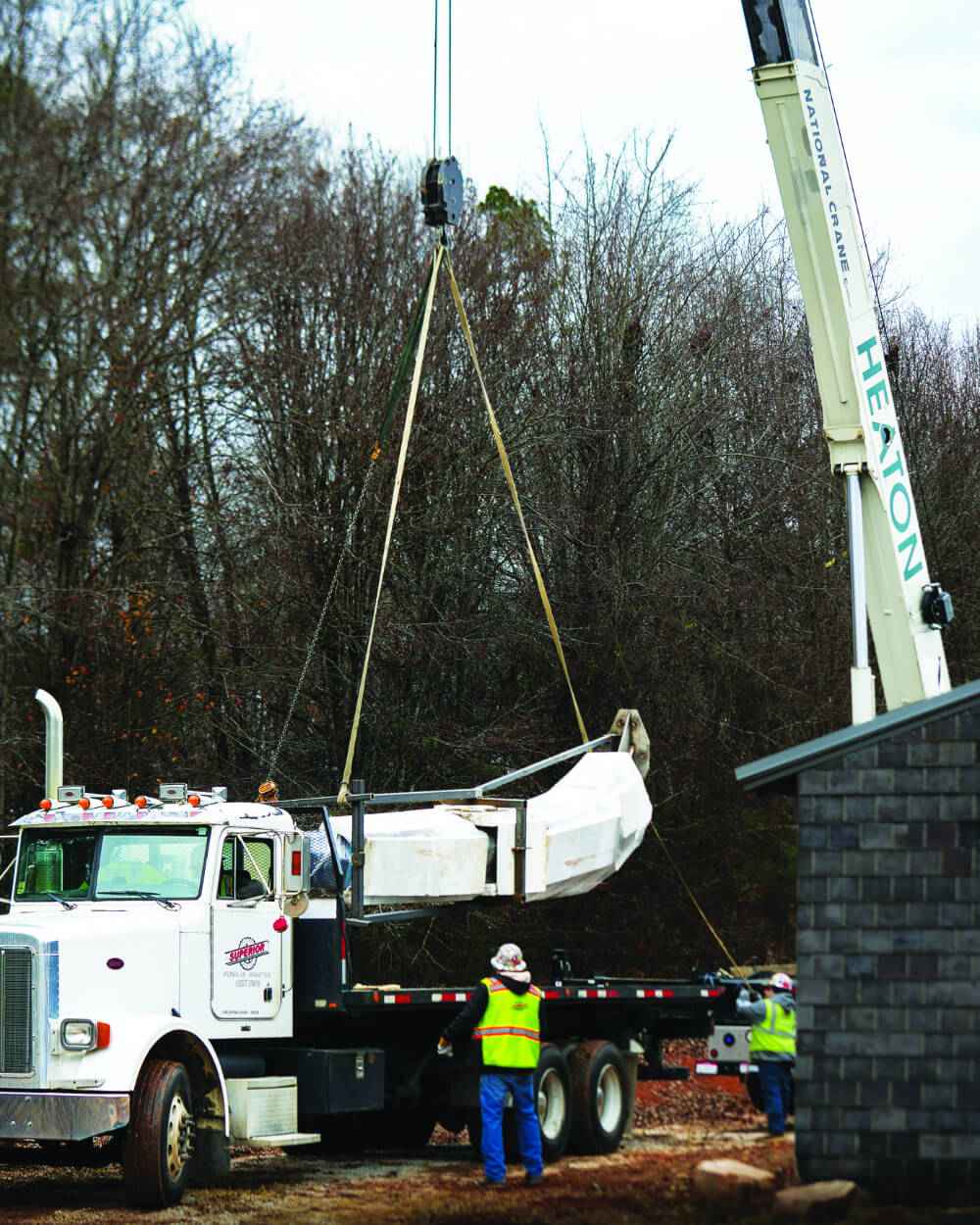
On this project, Heaton provided the crane and operator, and Superior handled the transportation and rigging.
Representatives of both companies advised Hart on the design, structure and rigging points of the frames he custom welded to support his sculpture’s sections during transportation and installation.
“We made site visits and looked at several rigging arrangements to make sure we had the best one,” said Superior’s project manager for cranes and rigging, Gage Williams. “And the team effort paid off in a smooth operation from start to finish.”
Unique Sculpture
Fully assembled, the Beacon stands about 20 feet high, 15 feet wide and 20 feet long.
It is a continuous flowing form with two arches and a multi-faceted shiny surface that glints in the sunlight and reflects viewers’ images back to them.
Trilith’s developers commissioned the sculpture specifically to be a focal point of the development and to represent the community’s spirit of creativity and unlimited possibilities.
“The sculpture represents the Trilith logo and symbolizes the identity and grand opening of the entire development,” said Williams. “It is a distinctive architectural feature and one of the most uniquely constructed sculptures that the Superior-Heaton team has worked with.”
Though made entirely of stainless steel, the Beacon’s four individual sections were not designed to be self supporting during transit and erection.
That meant that this project’s main hurdle was figuring out how to transport and assemble the sculpture’s sections intact.
On its surface, the job seemed straightforward.
Superior and Heaton needed to pick up each custom-fabricated section of the sculpture at the artist’s studio outside of Atlanta, drive about 20 minutes to the Trilith site, mount it onto anchor bolts, and then support all the sections until the sculptor could weld them together into the finished piece of art.
As with many projects, the challenge came in the details.
“The arch is a unique shape that required us to calculate where to put the rigging points so each section would lie level as we handled it for transport and to also stand vertically as we installed it,” said Williams. “Given the polished condition and unique geometry of the sculpture, we couldn’t rig directly to the pieces.”
Framing the Answer
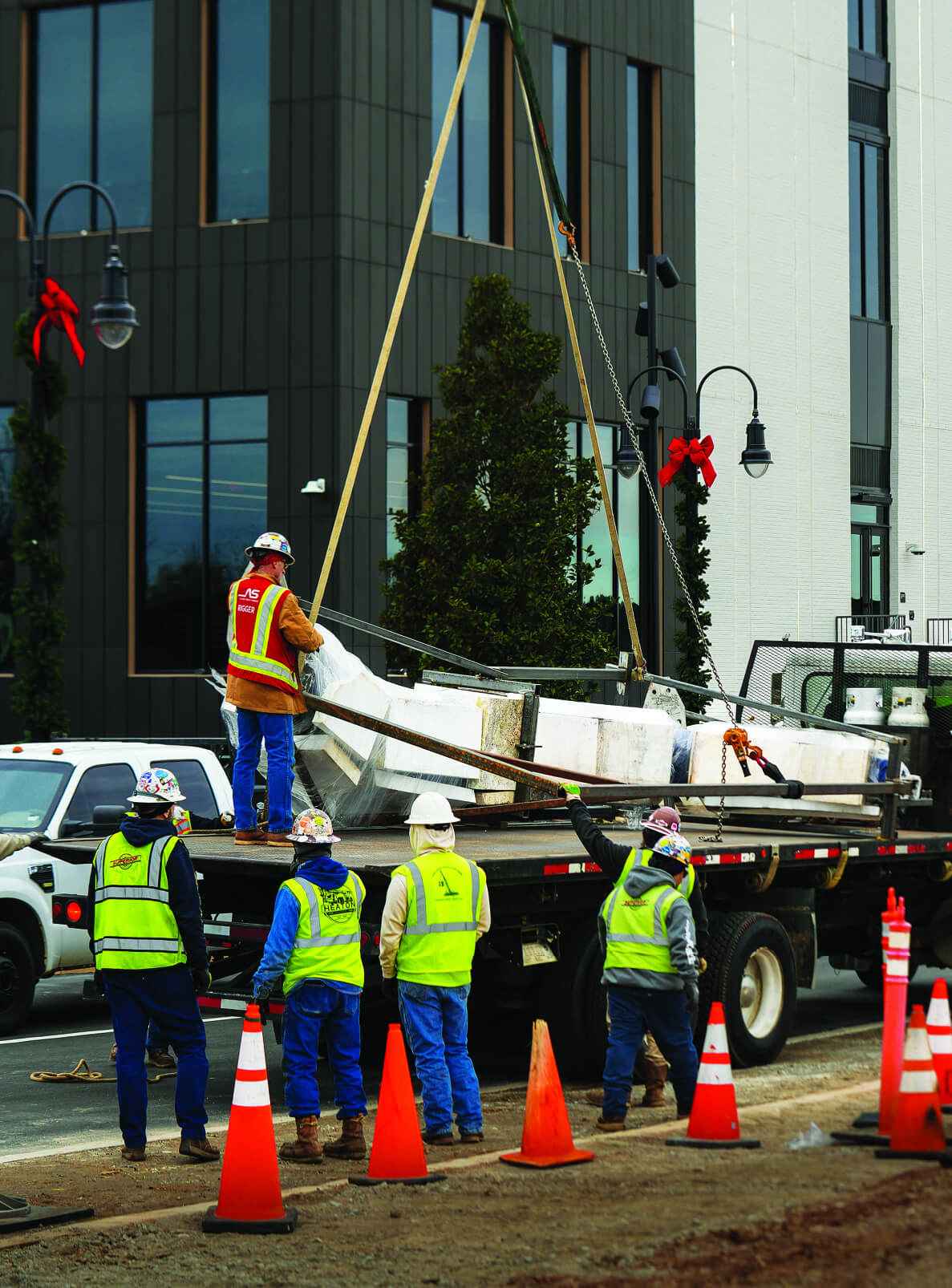
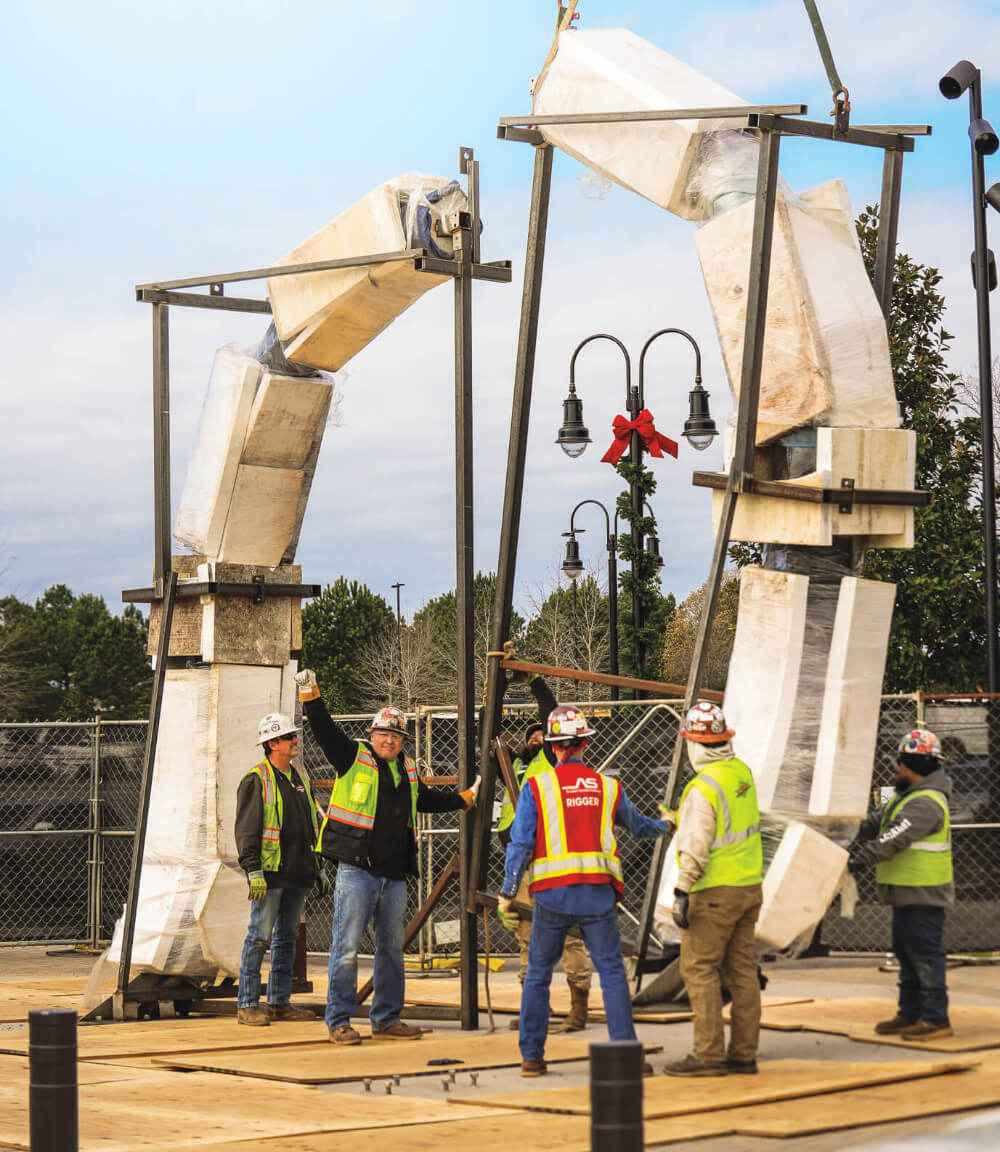
Combining Superior-Heaton’s rigging and lifting experience with Hart’s understanding of the Beacon’s structure, the team decided that the best solution was to protect each section with a custom-designed steel frame that would provide both support and rigging points without inducing any pressure.
Custom Frame and Tender Care
The primary goal was to create a frame that would keep each arch perfectly level while also ensuring a balanced lift.
“Because the arches were uniquely shaped and fabricated from stainless steel, which can flex under load, we could not introduce any pressure points or uneven stress during lifting or transport,” said Williams.
The team evaluated the geometry and weight distribution of each piece and determined that a fully framed structure would provide the most control.
The number and placement of braces were based on maintaining rigidity across the span of the arch while preventing deflection.
Sculptor Adam Hart fabricated the braces based on that analysis.
The bottom of the arch was welded to the base of the frame to secure it structurally.
Additional bracing was positioned to stabilize the vertical and curved sections without contacting visible finished surfaces.
“The result was a rigid lifting structure that essentially turned each sculpture piece into a controlled, predictable load,” said Williams.
Because the team couldn’t attach slings directly to the sculpture without risking damage, Superior had to engineer the lifting points into the frame.
Lifting lugs were placed on the frame at positions that would allow the load to remain level throughout the lift.
Their locations ensured that weight was distributed evenly across the frame and that no twisting or shifting would occur once the crane took tension.
“The goal was to make the lift behave as if it were a standard structural load,” said Williams.
To keep a sculpture section from shifitng in its protective frame during lifting and transport, the bottom of each arch was welded directly to the base of the frame.
In addition, upper parts of the frame were welded to structural elements of the arch that would not be seen in the finished installation.
Inside the frame, moving blankets were wrapped around the sculpture to protect finished stainless steel surfaces, Styrofoam provided cushioning and shrink wrap helped hold those protective layers in place during transport and installation.
After all four arches were installed and welded into the completed sculpture, the artist carefully removed the lifting frames and protective materials.
“We moved and installed two sections, or one arch, per day,” said Williams. “We decided to do just one arch a day to ensure that the crew stayed sharp and kept a high level of focus throughout the job.“
Perfect Crane
For this project, Superior and Heaton chose a 45-ton capacity National Crane NBT 45-2 boom truck because it combined the required lifting capacity, reach, roadability and compactness.
“It was compact enough to maneuver into the artist’s yard and around his shop, yet powerful enough to set the 4,000-pound sections at a 45-foot radius on the installation site,” said Williams. “Its precise control let the operator line up holes in the base sections over anchor bolts.”
Total Team Success
“It was a smooth operation in which each part of the team did its part flawlessly,” said Lewis. “The sculptor, Superior and Heaton all worked together seamlessly to make this project a success. We are all so proud to have been part of this.”