
Tough and Ready
Rough terrain cranes are poised to support strong opportunities across multiple end-user sectors
The outlook for the rough terrain market remains positive. “It’s supported by several key growth drivers expected to shape demand in the coming years,” said Ernst Andreas, president of Raimondi North America. “Ongoing critical infrastructure investments will continue to play a central role, particularly across bridge and highway developments, as well as other large-scale civil projects.
“In parallel, reflecting broader industrial and digital transformation trends, increasing investment in data centers and the expansion of local manufacturing capabilities are emerging as important contributors to rough terrain market growth,” Andreas added. “Additionally, the sustained momentum within the oil and gas sector is expected to further support demand for rough terrain cranes, particularly in regions where energy projects remain a key economic driver.”
John Bair, product manager for rough terrain cranes at Manitowoc, noted that fleet utilization of rough terrain cranes remains high, with operators increasingly turning to higher-capacity models to meet evolving jobsite requirements. “Looking ahead through 2026, the outlook for the rough terrain crane market remains strong, supported by continued investment across infrastructure, energy and utility sectors,” he said.
“North America continues to be the biggest and strongest market for rough terrain cranes, where aging infrastructure at airports, highways, bridges, water plants and more are driving the need for upgrades,” Bair continued. “There is also the ongoing expansion of data centers, warehouses and industrial facilities that are sustaining high demand.”
“The current state of the rough terrain market continues to show a positive trend and should meet or slightly exceed the previous year’s performance in 2026,” said Dan Melnyk, vice president of mobile crane sales - North America at Tadano. “The market continues to see solid demand for over 100-ton capacity rough terrain cranes. At the same time, capacities in highest demand are in the 130- and 160-ton segments with AI data center and semiconductor chip plant builds, and infrastructure projects related to oil and gas, driving growth.”
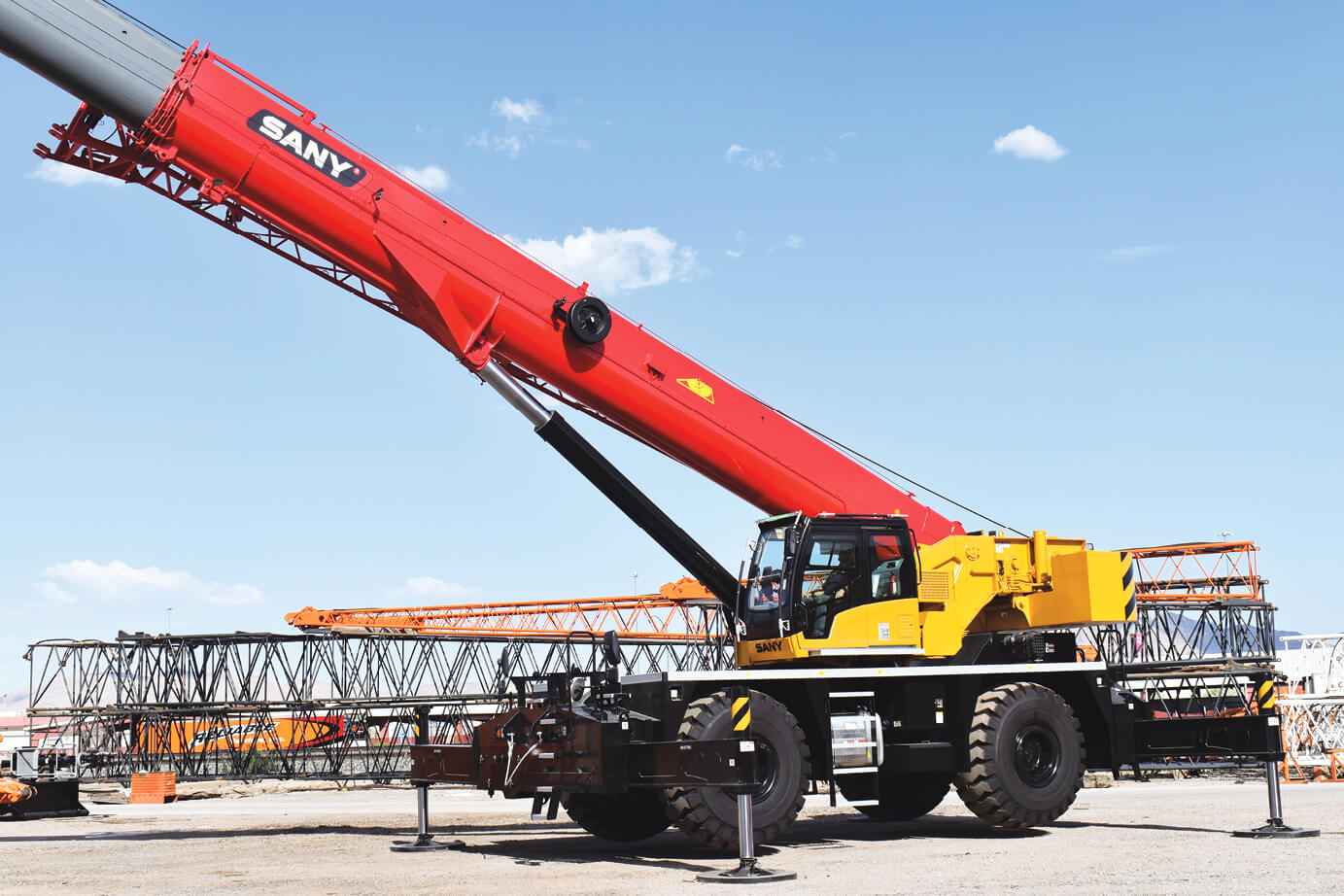
“We see solid growth in the rough terrain market, but nothing explosive, mainly due to availability and tariff issues that are affecting a lot of manufacturers,” said Brian Smoot, director/general manager cranes at SANY America.
“High utilization in the rental market is driving end users to look at new purchases. At the same time, the work is there on infrastructure, bridge, data center and utility projects and the highest demand for rough terrains continues to be in the 100- to 160-ton classes.”
Into the second quarter of 2026, the rough terrain market in North America remains steady, noted Kelly Fiechter, product manager for rough terrain cranes at Link-Belt. “We continue to see a steady flow of cranes going to rental fleets as well as contractor-owned fleets for infrastructure and project work. We anticipate this will remain the case throughout the year.”
Technology Needs
While demand for rough terrain cranes is growing, related Manitowoc’s John Bair, expectations for crane performance also continue to rise. “Contractors are placing greater emphasis on reliability, ease of operation and the ability to maximize uptime, as these factors directly impact productivity and return on investment,” he pointed out. “This is driving demand for cranes that combine strong lifting performance with intuitive controls, along with compact design, efficient transport and fast setup capabilities.
“Digitalization is also playing an increasingly important role in shaping the market,” Bair continued. “Data-driven insights are becoming essential tools for fleet management, helping owners better understand utilization and minimize downtime. Telematics will be a key to the future, as customers are looking for predictive maintenance, better understanding of utilization as well as remote diagnostic capabilities. As these technologies continue to advance, they are expected to further enhance jobsite efficiency and overall fleet performance.”
Latest Models
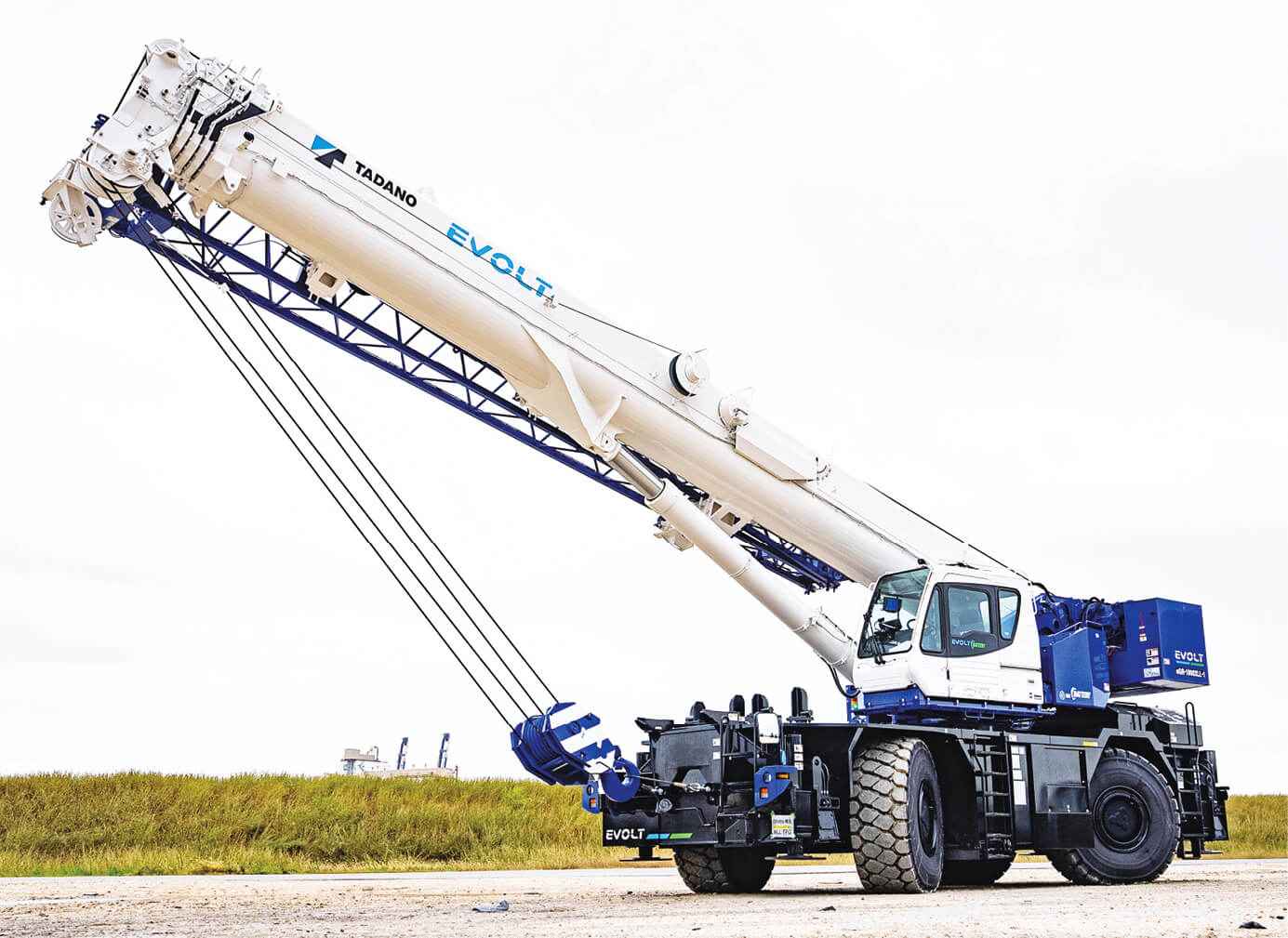
Recent introductions of rough terrain cranes to the U.S. market include the Tadano EVOLT eGR-1000XLL-1 fully electric 100-ton capacity model. The rough terrain crane has a 167.3-foot five-section boom and an optional 33.2 foot / 58.1 foot bi-fold jib to provide a maximum lifting height of 224.1 feet.
The EVOLT eGR-1000XLL-1 is powered by a 226-kilowatt-hour lithium-ion battery that enables up to seven hours of lifting, or a typical work cycle of five hours of lifting plus 5.5 miles of travel on a single charge. With crane operation noise reduced to 99 decibels — 9 decibels lower than diesel models — the model is ideal for urban and regulated jobsites.
The Tadano GR-1600XL rough terrain crane is a 270-horsepower Cummins diesel powered, 160-ton capacity model with a maximum lifting height of 302.5 feet. Its six-section boom extends from 42.8 to 200.1 feet, and it can be equipped with a 33.8-foot / 59.1-foot bi-fold jib for added reach. The crane features the manufacturer’s AML-C system that detects asymmetrical outrigger positions and calculates available lifting capacity accordingly, HELLO-NET telematics for monitoring and maintenance planning and self-removable counterweight and outrigger boxes to simplify transport.
Under the Raimondi Group, the Terex Rough Terrain division has recently expanded its offerings of the TRT 80US and TRT 100US models for the North American market with the TRT 55US.
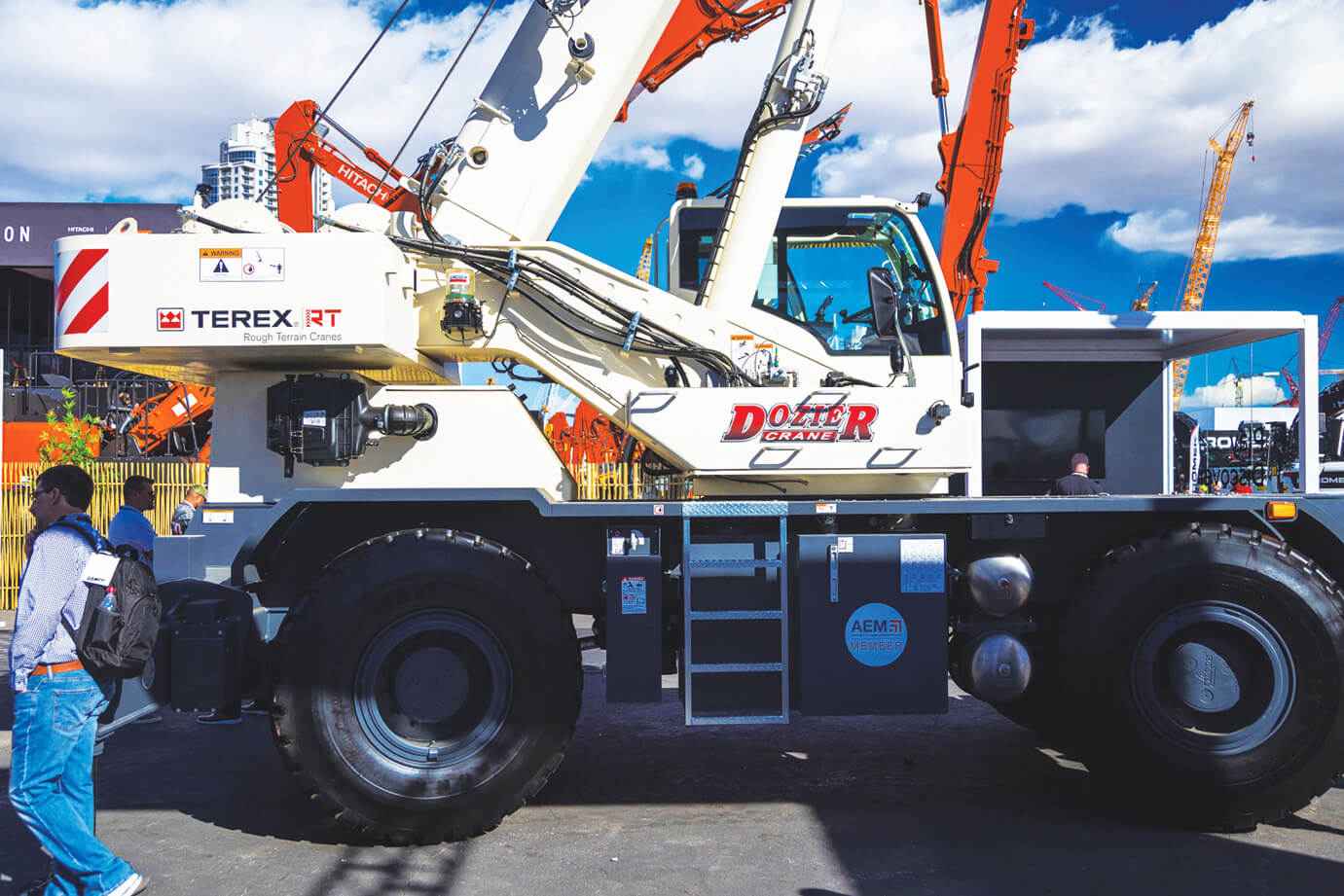
The Terex TRT 55US model features an additional jib configuration for versatility and has a 55-ton lifting capacity and a maximum jib length of 122.7 feet. A distinctive feature is the Proportional Telescoping Boom mode. Reaching a maximum tip height of 130 feet with the main boom, the TRT 55US can be equipped with an additional 26.25-foot jib, extending the maximum tip height to 157.5 feet.
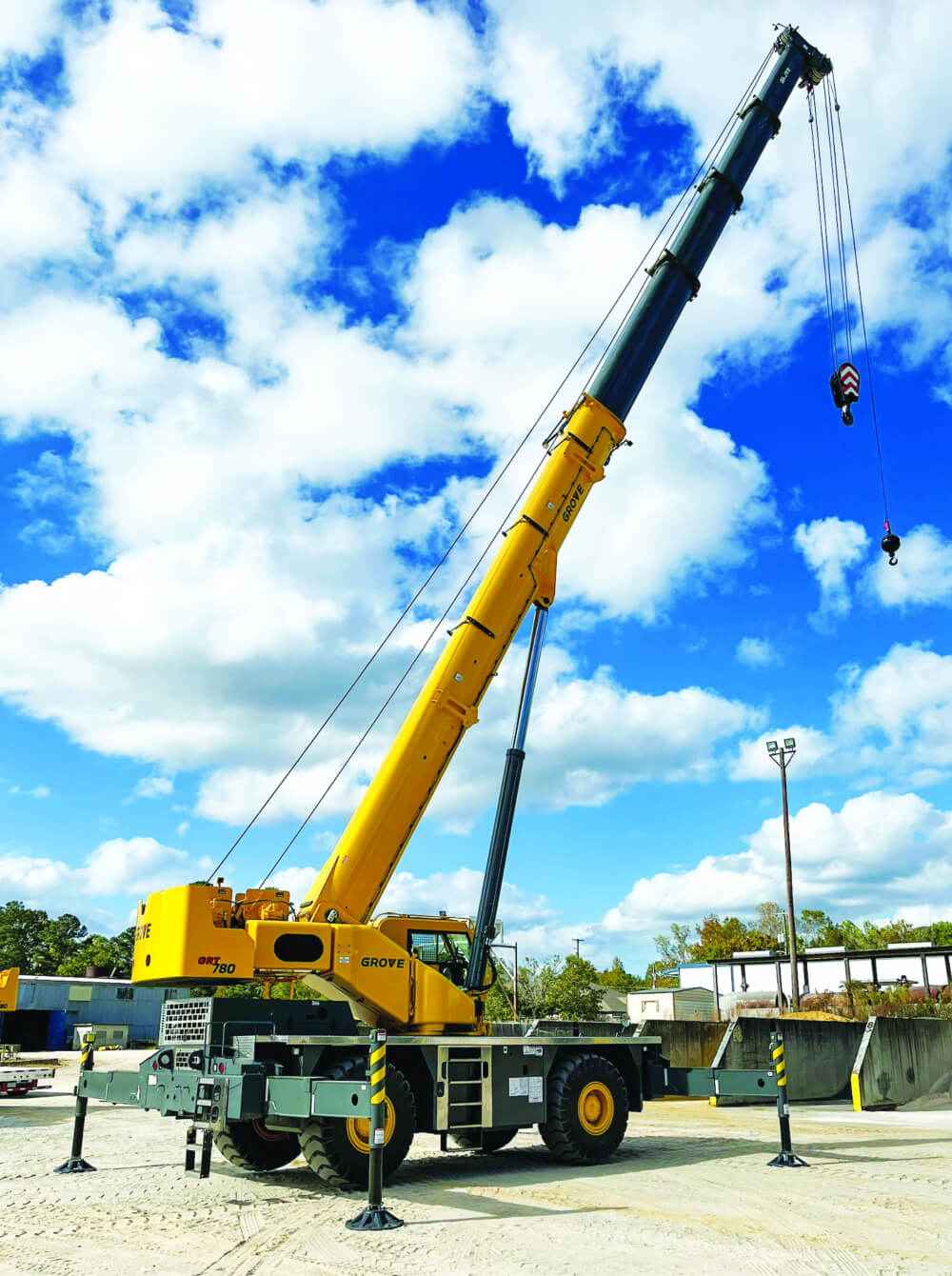
Manitowoc’s newest Grove rough terrain cranes are the 65-ton GRT765 and the 80-ton GRT780. The Grove GRT765 has a 126-foot four-section full power boom and the GRT780 is equipped with a 155-foot five-section full-power boom. Both models feature a 35- to 56-foot bi-fold swingaway jib, which can be manually offset up to 45 degrees.
Both cranes typically travel as one load, with the GRT765 having a GVW of approximately 94,000 pounds. For the GRT780, GVW is 99,500 pounds. The rough terrains are also equipped with the MAXbase variable outrigger positioning system and are the first models from the manufacturer to offer the Grove CONNECT telematics and fleet management system.
With the latest technologies, rough terrain cranes from the industry’s manufacturers are well positioned to support an expanding market environment.