
Tadano Introduces AC 3.060-2 All Terrain Crane
Tadano's AC 3.060-2 all terrain crane is available to order in the Americas and Australia, with deliveries expected later this year.
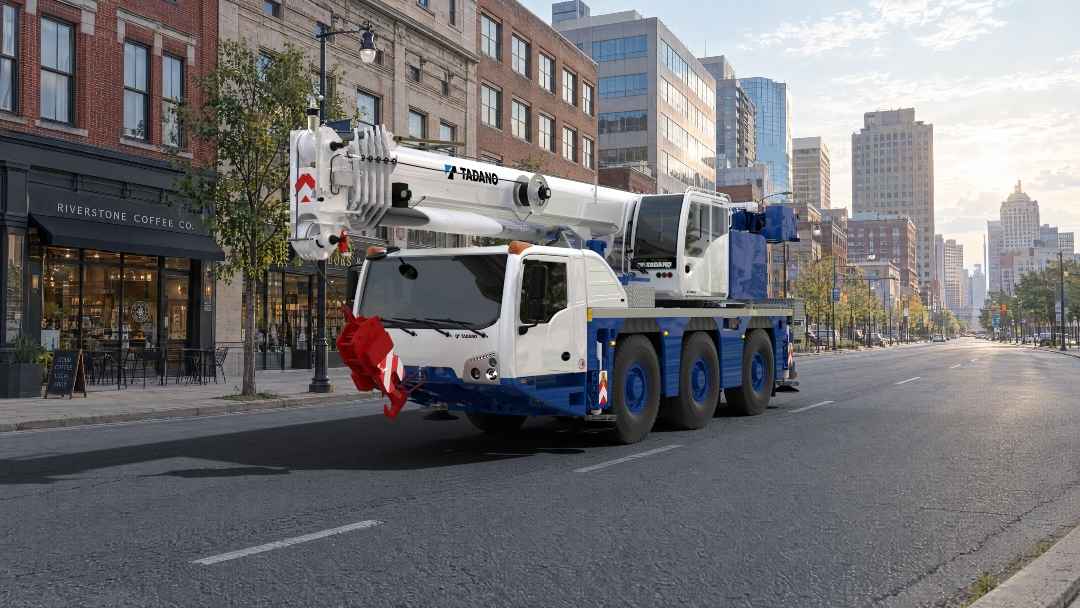
September 29, 2026 - Tadano has introduced the AC 3.060-2, a three-axle all terrain crane designed for taxi crane applications and quick setup. The crane is now available to order in the Americas and Australia, with first deliveries expected later this year. In Europe, deliveries are scheduled to begin in 2027.
The AC 3.060-2 is the second small two- and three-axle all terrain crane produced in Japan as Tadano expands production capacity. The company said the increased capacity is intended to support greater availability and shorter lead times for cranes in this class.
“With our new AC 3.060-2, we have created a compact and powerful crane that can cover an extremely wide range of applications without much effort. That was our development goal – and we have definitely achieved it,” emphasizes Masafumi Nakamura from the product development division at Tadano Japan.
Lifting Performance
The crane is equipped with a 50-meter (164-foot) main boom and can use a 16-meter (52.5-foot) extension. According to Tadano, with the main boom fully extended, a 13-tonne (28,700 pounds) counterweight, and a working radius of 18 meters (59 feet), the AC 3.060-2 can lift 5.8 tonnes (12,800 pounds).
With the main boom at maximum length and the 16-meter extension angled at 20 degrees, the crane can lift 2.3 tonnes (3,500 pounds) at a 28-meter (92-foot) radius with the full counterweight. Tadano identifies this as a best-in-class capacity. The maximum system length is 69 meters (216.5 feet).
“This strong performance with a steep boom angle proves particularly advantageous when lifting heavy loads over obstacles,” emphasizes Nakamura.
The AC 3.060-2 also has a single-line pull of 6.7 tonnes (15,040 pounds), which Tadano identifies as best-in-class. With triple reeving on the single-sheave hook block, the rope can handle up to 20 tonnes (44,100 pounds), according to the company.
Tadano said the line pull allows the crane to handle heavier loads with the smaller hook block and reduces the amount of reeving required during setup.
Road and Jobsite Configuration
For road travel, the AC 3.060-2 has a 12-tonne (26,500 pounds) axle load limit and is equipped with 16-inch tires, a six-by-six-by-six drivetrain, 4.2 tonnes (9,300 pounds) of counterweight, a single-sheave hook block, and a 300 kg (660-pound) payload.
The crane also has a turning assistant intended to help the driver maintain an overview of the road. Tadano said the configuration can support operations that do not require additional transport.
At the jobsite, the crane has a clearance height of 3.71 meters (12 feet, 4 inches), a width of 2.55 meters (8 feet, 4 inches), and a carrier length of 9.49 meters (31 feet, 2 inches). These dimensions allow the crane to operate in confined areas, including halls, according to Tadano.
An optional Surround View system uses four cameras to assist with crane positioning. The Flex Base system provides stepless outrigger positioning, allowing the outriggers to be extended to different lengths when working near obstacles.
The AC 3.060-2 also uses Tadano's IC-1 Plus crane control system with capacity radar. The system can account for asymmetrical outrigger setups when determining available lifting capacity.
The boom is positioned beneath the floor of the crane, which Tadano said supports reeving and setup of extensions.
Shared Components and Optional Equipment
The AC 3.060-2 uses components shared with other Tadano cranes as part of the company's parts-sharing strategy. Examples include the runner and jib.
With the appropriate preparation, the crane can also be used with Tadano's e-Pack system for emission-free crane operation. Load and winch cameras are available as optional equipment.
Tadano said the AC 3.060-2 is intended for applications including concrete work, unloading, hall construction, and prefabricated house construction, as well as other lifting operations. The company also identified lifting air conditioning units onto roofs over obstacles and moving machinery with a jib in confined spaces as applications for the crane.